Things to do in New Delhi
Top sights and attractions to build your days around once you know when to go.

Qutb Minar
The Qutb Minar, also spelled Qutub Minar and Qutab Minar, is a minaret and victory tower, built during the Delhi sultanate, and comprising the Qutb complex, a UNESCO World Heritage Site in Mehrauli, South Delhi, India. It was mostly built between 1199 and 1220, contains 399 steps, and is one of the most frequented heritage spots in the city. After defeating Prithviraj Chauhan, the last Hindu ruler of Delhi before the Ghurid conquest of the region, Qutab-ud-din Aibak initiated the construction of the victory tower, but only managed to finish the first level. It was to mark the beginning of Islamic rule in the region. Successive dynasties of the Delhi Sultanate continued the construction, and, in 1368, Firuz Shah Tughlaq rebuilt the top parts and added a cupola.

Humayun's Tomb
Humayun's tomb is the tomb of the Mughal Emperor Humayun located in Delhi, India. The tomb was commissioned by Humayun's first wife and chief consort, Empress Bega Begum, under her patronage in 1558, and designed by the Persian architects Mirak Mirza Ghiyas and his son, Sayyid Muhammad, whom she personally chose. It was the first garden-tomb on the Indian subcontinent, and is located in Nizamuddin East, Delhi, close to the Dina-panah Citadel, also known as Purana Qila, that Humayun founded in 1538. It was also the first structure to use red sandstone at such a scale.

Jama Masjid, Delhi
The Masjid-i-Jehan-Numa, commonly known as the Jama Masjid, in Old Delhi area of Delhi, is one of the largest mosques in India. Its builder was the Mughal emperor Shah Jahan, between 1644 and 1656, and it was inaugurated by its first Imam, Syed Abdul Ghafoor Shah Bukhari. Situated in the Mughal capital of Shahjahanabad, it served as the imperial mosque of the Mughal emperors until the demise of the empire in 1857. The Jama Masjid was regarded as a symbolic gesture of Mughal power across India. It was also a site of political significance during several key periods of British rule. It remains in active use, and is one of Delhi's most iconic sites, closely identified with the methods of Old Delhi. The mosque structure is a Monument of National Importance.

Lotus Temple
The Lotus Temple is a Baháʼí House of Worship in Delhi, India. It was completed in December 1986. Notable for its lotus-like shape, it has become a prominent attraction in the city. Like all Bahá’í Houses of Worship, the Lotus Temple is open to all people, regardless of religion or any other qualification. The building is composed of 27 free-standing marble-clad "petals" arranged in clusters of three to form nine sides, with nine doors opening onto a central hall with a height of slightly over 34 metres and a capacity of 1,300 people. The Lotus Temple has won numerous architectural awards and has been featured in many newspaper and magazine articles.

India Gate
The India Gate is a war memorial located near the Rajpath on the eastern edge of the "ceremonial axis" of New Delhi. It stands as a memorial to 74,187 soldiers of the Indian Army who died between 1914 and 1921 in the First World War, in France, Flanders, Mesopotamia, Persia, East Africa, Gallipoli and elsewhere in the Near and the Far East, and the Third Anglo-Afghan War. 13,300 servicemen's names, including some soldiers and officers from the United Kingdom, are inscribed on the gate. Designed by Edwin Lutyens, the gate evokes the architectural style of the ancient Roman triumphal arches, such as the Arch of Constantine in Rome, and later memorial arches; it is often compared to the Arc de Triomphe in Paris, and the Gateway of India in Mumbai.

iron pillar of Delhi
The iron pillar of Delhi is a metal structure 7.21 metres high with a 41-centimetre (16 in) diameter that was constructed by Chandragupta II, and now stands in the Qutb complex at Mehrauli in Delhi, India.

Akshardham
Swaminarayan Akshardham is a Hindu temple and campus in Delhi, India. The temple is close to the border with Noida. Also known as Akshardham Temple or Akshardham Delhi, the complex displays traditional and modern Hindu culture and architecture. Inspired by Yogiji Maharaj and created by Pramukh Swami Maharaj, it was constructed by BAPS. It is the world's second-largest BAPS Hindu temple, following Akshardham, New Jersey, in the United States.

Qutb complex
The Qutb Minar complex are monuments and buildings from the Delhi Sultanate at Mehrauli in Delhi, India. Construction of the Qutub Minar "victory tower" in the complex, named after the religious figure Sufi Saint Khwaja Qutbuddin Bakhtiar Kaki, was begun by Qutb-ud-din Aibak, who later became the first Sultan of Delhi of the Mamluk dynasty. It was continued by his successor Iltutmish, and finally completed much later by Firoz Shah Tughlaq, a Sultan of Delhi from the Tughlaq dynasty (1320–1412) in 1368 AD. The Qubbat-ul-Islam Mosque, later corrupted into Quwwat-ul Islam, stands next to the Qutb Minar. The Qutub Minar also bears numerous inscriptions in Arabic and Nagari characters at various locations, which reveal its history.
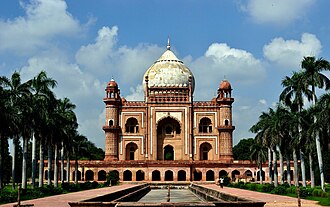
Tomb of Safdar Jang
The Tomb of Safdar Jang is a sandstone and marble mausoleum in Delhi, India. It was built in 1754 in the late Mughal Empire style for Nawab Safdarjung. Safdarjung, Nawab of Awadh, was made prime minister of the Mughal Empire when Ahmed Shah Bahadur ascended the throne in 1748.

Jawaharlal Nehru Stadium
Jawaharlal Nehru Stadium is a multi-sports stadium located in New Delhi, India. It is named after the first Prime Minister of India. Primarily a venue for football and athletics, it is an all-seater 60,254-capacity stadium, designed and constructed to meet the international standards set by FIFA, the Asian Football Confederation (AFC), and World Athletics (WA). It is the fourth largest stadium in India, 27th largest stadium in Asia and the 103rd largest stadium in the world, in terms of seating capacity.

National Museum
The National Museum, New Delhi, also known as the National Museum of India, is one of the largest museums in India. Established in 1949, it holds a variety of articles ranging from the pre-historic era to modern works of art. It functions under the Ministry of Culture, Government of India. The museum is situated on Janpath. The blueprint of the National Museum had been prepared by the Gwyer Committee set up by the Government of India in 1946. The museum has around 200,000 works of art, mostly Indian, but some of foreign origin, covering over 5,000 years.

Raj Ghat and associated memorials
Raj Ghat is a memorial complex in New Delhi, though part of Central Delhi, Delhi, India.
Places from Wikidata and Wikipedia.
Contains affiliate links.