Discover the best time of year, based on historical climate, temperature, and precipitation.
The best weather in Delhi is from February, November, December. — consistent weather climate
🌡Hot & dry
Contains affiliate links.
| Score | 91 | 95 | 94 | 46 | 32 | 16 | 11 | 13 | 19 | 74 | 99 | 99 |
|---|---|---|---|---|---|---|---|---|---|---|---|---|
| Climate | Mild | Mild | Pleasant | Hot & dry | Hot & dry | Hot & dry | Hot & rainy | Hot & rainy | Hot & rainy | Hot & dry | Pleasant | Mild |
| Temperature | 8–19°C | 11–24°C | 16–29°C | 21–36°C | 25–39°C | 28–38°C | 27–34°C | 26–33°C | 25–33°C | 20–32°C | 15–27°C | 9–21°C |
| Feels like | 6–18°C | 9–23°C | 15–29°C | 21–36°C | 26–40°C | 31–42°C | 32–40°C | 31–39°C | 29–38°C | 21–33°C | 14–26°C | 8–20°C |
| Precipitation | 33mm 4 days | 23mm 2 days | 31mm 3 days | 10mm 1 days | 31mm 2 days | 62mm 5 days | 242mm 21 days | 164mm 20 days | 125mm 11 days | 18mm 2 days | 6mm 1 days | 7mm 1 days |
| Sunshine | 8.9h ☀︎ 84% | 9.8h ☀︎ 87% | 11.0h ☀︎ 91% | 11.3h ☀︎ 88% | 11.2h ☀︎ 83% | 11.0h ☀︎ 79% | 7.9h ☀︎ 58% | 8.0h ☀︎ 61% | 10.1h ☀︎ 82% | 10.6h ☀︎ 93% | 9.8h ☀︎ 92% | 9.2h ☀︎ 89% |
| Wind | NW · 13 km/h | NW · 15 km/h | NW · 17 km/h | NW · 18 km/h | N · 19 km/h | N · 18 km/h | SE · 15 km/h | SE · 15 km/h | NE · 14 km/h | NW · 12 km/h | NW · 12 km/h | NW · 12 km/h |
| Humidity (%) | 79% | 69% | 58% | 36% | 39% | 52% | 77% | 80% | 76% | 64% | 65% | 71% |
| Day length | 10.5h | 11.2h | 12.0h | 12.9h | 13.6h | 13.9h | 13.8h | 13.1h | 12.3h | 11.5h | 10.7h | 10.4h |
The festival of lights transforms Delhi with oil lamps, elaborate fireworks, and illuminated markets across the city, us…
The festival of colors fills Delhi's streets, parks, and temples with crowds throwing colored powder and water, typicall…
Delhi hosts India's largest national celebration on January 26, with a grand military and cultural parade along Kartavya…
Every guidebook will tell you that November is the only time to visit Delhi, but March is the true masterclass in timing: you trade a sliver of autumn cool for half the crowds, blossoming gardens, and clear, golden light before the furnace switches on.
Delhi is an imperial palimpsest, a sprawl of ancient citadels, Mughal masterworks, and wide colonial avenues layered along the Yamuna river. It is a city that does not invite passive sightseeing; it engulfs you. From the towering sandstone spire of the Qutub Minar to the red ramparts of the Red Fort, its monuments were built to proclaim sovereign scale, and walking through them requires endurance even in the gentlest conditions. When you visit determines whether you experience Delhi as an intoxicating, vibrant epic or as an exhausting sensory siege.
Standard travel itineraries herd visitors into the capital toward the end of the year, leaving March criminally overlooked. This is the city at its most generous. The biting cold of winter mornings has lifted, the intense summer heat has not yet settled, and daily highs rest comfortably around 29 degrees. Trees across the city burst into flower, bougainvillea drapes across old stone walls, and the sun stays out for eleven unhurried hours a day.
Critically, the tourist masses that choked the monuments three months earlier have thinned to nearly half their peak. You can wander the sprawling garden terraces of Humayun's Tomb or the leafy grounds around the Qutub Minar without feeling corralled by tour groups. The air holds an easy warmth that makes long walks between colonial colonnades in Connaught Place a pleasure rather than a trial.
March also belongs to Holi. The festival of colors unleashes a wave of brilliant magenta and marigold powder across residential streets, parks, and temple courtyards. It is messy, joyful, and utterly disarming, a vivid explosion of community that marks the end of winter and sets the tone for Delhi's sweetest, briefest window of open-air freedom.
On paper, November offers flawless weather: gentle daytime highs around 27 degrees, no rain, and mild evenings. In practice, it is Delhi at its most suffocating. November is the single busiest month on the city's calendar. Hotel rates spike, lines at ticket booths snake into the roadways, and the sheer volume of humanity navigating the narrow alleys of Chandni Chowk can test anyone's patience.
Atmospheric conditions during late autumn and early winter also work against the traveler. Diwali arrives in October or November, setting off days of glittering night markets, illuminated balconies, and relentless fireworks. But as temperatures drop, cooler air traps smoke and dust over the plains, turning the skyline grey and making long outdoor days taxing on the throat and eyes. November looks pristine in weather charts; in real life, it demands steady endurance.
By January, deep winter arrives. Days drop into the upper teens, and early mornings are frequently draped in a biting, dense fog that can delay trains and blot out city landmarks until noon. If you are seated along Kartavya Path on a frosty January morning for the Republic Day Parade, you will need serious woolens to watch the mechanized battalions and folk troupes roll past. February eases that bite, offering warm afternoons and lush lawns, but visitor numbers remain elevated through the end of winter.
Come April, the plains turn into a kiln. The transition is swift and unsparing. By May, the mercury punches toward 40 degrees, and the apparent heat crawls even higher. A dry, baking wind whips fine dust across the asphalt, driving anyone with a choice indoors between ten in the morning and five in the evening.
Attempting to explore vast outdoor heritage grounds like the Red Fort or the ruins of Purana Qila during these months is an exercise in heat exhaustion. The stone radiates absorbed sunlight, and shade is scarce. The city does not stop—it is too vast and too vital for that—but its tempo shifts entirely. Life retreats behind drawn curtains and hums under air conditioners until twilight, when street markets suddenly buzz with late-night food vendors and families strolling in the dark to catch an elusive stray breeze.
July brings the rains, and with them, an oppressive, suffocating humidity. While the downpours offer theatrical drama—transforming dried-out parks into vivid, overgrown green carpets almost overnight—they don't cool the city down. Highs hover in the mid-thirties, but the moisture in the air makes it feel closer to 40 degrees day after day.
When a monsoon deluge hits, Delhi's infrastructure buckles. Low-lying avenues flood, traffic stalls for hours on major arteries, and navigating the waterlogged lanes of Chandni Chowk becomes an athletic challenge. August and September continue the damp, muggy cycle. It is a cinematic time to watch thunderheads roll over the Yamuna, but a terrible time for an itinerary that relies on walking.
October is the pivot. The monsoon rains retreat, the humidity falls off a cliff, and the city begins to stir outdoors again. Daily highs still linger in the lower thirties, but the suffocating moisture is gone, replaced by dry air and clear blue skies.
Anticipation builds across the capital throughout October as markets dress up for Diwali. While early October can still feel slightly hot at midday, by month's end the evenings turn crisp and cool. It is the beginning of the great return to street life, but smart travelers treat it as the countdown to March, when the beauty returns without the autumn crowds.
Top sights and attractions to build your days around once you know when to go.
Humayun's tomb is the tomb of the Mughal Emperor Humayun located in Delhi, India. The tomb was commissioned by Humayun's first wife and chief consort, Empress Bega Begum, under her patronage in 1558, and designed by the Persian architects Mirak Mirza Ghiyas and his son, Sayyid Muhammad, whom she personally chose. It was the first garden-tomb on the Indian subcontinent, and is located in Nizamuddin East, Delhi, close to the Dina-panah Citadel, also known as Purana Qila, that Humayun founded in 1538. It was also the first structure to use red sandstone at such a scale.
The Masjid-i-Jehan-Numa, commonly known as the Jama Masjid, in Old Delhi area of Delhi, is one of the largest mosques in India. Its builder was the Mughal emperor Shah Jahan, between 1644 and 1656, and it was inaugurated by its first Imam, Syed Abdul Ghafoor Shah Bukhari. Situated in the Mughal capital of Shahjahanabad, it served as the imperial mosque of the Mughal emperors until the demise of the empire in 1857. The Jama Masjid was regarded as a symbolic gesture of Mughal power across India. It was also a site of political significance during several key periods of British rule. It remains in active use, and is one of Delhi's most iconic sites, closely identified with the methods of Old Delhi. The mosque structure is a Monument of National Importance.
The Lotus Temple is a Baháʼí House of Worship in Delhi, India. It was completed in December 1986. Notable for its lotus-like shape, it has become a prominent attraction in the city. Like all Bahá’í Houses of Worship, the Lotus Temple is open to all people, regardless of religion or any other qualification. The building is composed of 27 free-standing marble-clad "petals" arranged in clusters of three to form nine sides, with nine doors opening onto a central hall with a height of slightly over 34 metres and a capacity of 1,300 people. The Lotus Temple has won numerous architectural awards and has been featured in many newspaper and magazine articles.
The India Gate is a war memorial located near the Rajpath on the eastern edge of the "ceremonial axis" of New Delhi. It stands as a memorial to 74,187 soldiers of the Indian Army who died between 1914 and 1921 in the First World War, in France, Flanders, Mesopotamia, Persia, East Africa, Gallipoli and elsewhere in the Near and the Far East, and the Third Anglo-Afghan War. 13,300 servicemen's names, including some soldiers and officers from the United Kingdom, are inscribed on the gate. Designed by Edwin Lutyens, the gate evokes the architectural style of the ancient Roman triumphal arches, such as the Arch of Constantine in Rome, and later memorial arches; it is often compared to the Arc de Triomphe in Paris, and the Gateway of India in Mumbai.
Swaminarayan Akshardham is a Hindu temple and campus in Delhi, India. The temple is close to the border with Noida. Also known as Akshardham Temple or Akshardham Delhi, the complex displays traditional and modern Hindu culture and architecture. Inspired by Yogiji Maharaj and created by Pramukh Swami Maharaj, it was constructed by BAPS. It is the world's second-largest BAPS Hindu temple, following Akshardham, New Jersey, in the United States.
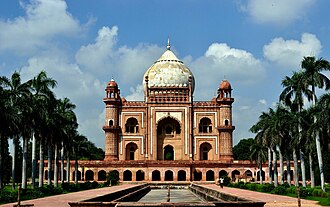
The Tomb of Safdar Jang is a sandstone and marble mausoleum in Delhi, India. It was built in 1754 in the late Mughal Empire style for Nawab Safdarjung. Safdarjung, Nawab of Awadh, was made prime minister of the Mughal Empire when Ahmed Shah Bahadur ascended the throne in 1748.
Jawaharlal Nehru Stadium is a multi-sports stadium located in New Delhi, India. It is named after the first Prime Minister of India. Primarily a venue for football and athletics, it is an all-seater 60,254-capacity stadium, designed and constructed to meet the international standards set by FIFA, the Asian Football Confederation (AFC), and World Athletics (WA). It is the fourth largest stadium in India, 27th largest stadium in Asia and the 103rd largest stadium in the world, in terms of seating capacity.

The National Museum, New Delhi, also known as the National Museum of India, is one of the largest museums in India. Established in 1949, it holds a variety of articles ranging from the pre-historic era to modern works of art. It functions under the Ministry of Culture, Government of India. The museum is situated on Janpath. The blueprint of the National Museum had been prepared by the Gwyer Committee set up by the Government of India in 1946. The museum has around 200,000 works of art, mostly Indian, but some of foreign origin, covering over 5,000 years.
Raj Ghat is a memorial complex in New Delhi, though part of Central Delhi, Delhi, India.
The Moti Masjid is a 17th-century historical mosque, not open for worship, inside the Red Fort complex in Old Delhi, India. It was built by Mughal emperor Aurangzeb, damaged during the Siege of Delhi, and subsequently restored by the British. Named for its white marble, the mosque features ornate floral carvings. It is an important example of Mughal architecture during Aurangzeb's reign.
Gandhi Smriti, formerly known as Birla House or Birla Bhavan, is a museum dedicated to Mahatma Gandhi, situated on Tees January Road, formerly Albuquerque Road, in New Delhi, India. It is the location where Mahatma Gandhi spent the last 144 days of his life and was assassinated on 30 January 1948. It was originally the house of the Birla family, Indian business tycoons. It is now home to the Eternal Gandhi Multimedia Museum, which was established in 2005.
Gurdwara Bangla Sahib is one of the most prominent Sikh gurdwaras, or Sikh house of worship, in Delhi, India, and known for its association with the eighth Sikh Guru, Guru Har Krishan, as well as the holy pond inside its complex, known as the "Sarovar." Originally a bungalow of Raja Jai Singh I of Amber, it was rebuilt as a small shrine by Sikh General Sardar Baghel Singh in 1783. In the same year, there was reconstruction of nine Sikh shrines in Delhi.
Places from Wikidata and Wikipedia.
Contains affiliate links.
National Capital Territory of Delhi · India