Things to do in Giza
Top sights and attractions to build your days around once you know when to go.

Cairo
Cairo is the capital and largest city of Egypt and the Cairo Governorate. It is home to more than 9.8 million people. It is also part of the largest urban agglomeration in Africa, the Arab world, and the Middle East. The Greater Cairo metropolitan area is one of the largest in the world by population with over 22 million people. Areas of what would become Cairo were inhabited from pre-dynastic and early-dynastic ancient Egypt c. 6000 years ago, as the Giza pyramid complex and the ancient cities of Memphis and Heliopolis are today within the city.

Great Pyramid of Giza
The Great Pyramid of Giza is the largest of the Egyptian pyramids and the most famous landmark of the Giza pyramid complex in Giza, Egypt. It is the oldest of the Seven Wonders of the Ancient World, and the only wonder that has remained largely intact. The Great Pyramid served as the tomb of Egyptian Pharaoh Khufu ("Cheops"), who ruled during the Fourth Dynasty of the Old Kingdom. It was built c. 2600 BC over a period of about 26 years.

Giza pyramid complex
The Giza pyramid complex in Egypt is home to the Great Pyramid, the pyramid of Khafre, and the pyramid of Menkaure, along with their associated pyramid complexes and the Great Sphinx. All were built during the Fourth Dynasty of the Old Kingdom of ancient Egypt, between c. 2600 – c. 2500 BC. The site also includes several temples, cemeteries, and the remains of a workers' village.
Giza Necropolis
The Giza pyramid complex in Egypt is home to the Great Pyramid, the pyramid of Khafre, and the pyramid of Menkaure, along with their associated pyramid complexes and the Great Sphinx. All were built during the Fourth Dynasty of the Old Kingdom of ancient Egypt, between c. 2600 – c. 2500 BC. The site also includes several temples, cemeteries, and the remains of a workers' village.

Egyptian pyramids
The Egyptian pyramids are ancient masonry structures located in Egypt. Most were built as tombs for the pharaohs and their consorts during the Old and Middle Kingdom periods. At least 138 identified pyramids have been discovered in Egypt. Approximately 80 pyramids were built within the Kingdom of Kush, now located in the modern country of Sudan.

The Great Sphinx
The Great Sphinx of Giza is a limestone statue of a resting sphinx, a mythical creature with the head of a human and the body of a lion. The monument was sculpted from the limestone bedrock of the Eocene-aged Mokattam Formation and faces east on the Giza Plateau, on the west bank of the Nile in Giza, Egypt. The oldest known monumental sculpture in Egypt, the Sphinx is part of the Memphite Necropolis and is a UNESCO World Heritage Site.

Egyptian Museum
The Museum of Egyptian Antiquities, commonly known as the Egyptian Museum and also called the Cairo Museum or the Egyptian Museum in Cairo (EMC), is a national history museum in Cairo, Egypt.

Pyramid of Khafre
The pyramid of Khafre or of Chephren is the middle of the three Ancient Egyptian Pyramids of Giza, the second tallest and second largest of the group. It is the only pyramid out of the three that still has cladding at the top. It is the tomb of the Fourth-Dynasty Pharaoh Khafre (Chefren), who ruled c. 2558−2532 BC.

Grand Egyptian Museum
The Grand Egyptian Museum is a national archaeological museum in Giza, Egypt. Dedicated to Ancient Egypt and its culture, society, and artifacts, the GEM is the largest museum in the world for a single civilization.
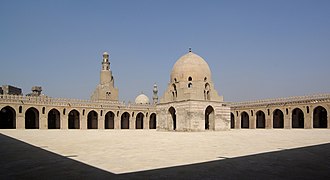
Mosque of Ibn Tulun
The Mosque of Ibn Tulun is a mosque in Islamic Cairo, Egypt. Built between 876 and 879 CE by its namesake, Ahmad ibn Tulun, it is the oldest well-preserved mosque in Egypt. Its design was inspired by the 9th-century mosques of Samarra in Iraq, the Abbasid capital at the time, making it an important representative of classical Abbasid architecture. It is one of the most significant monuments of Islamic architecture in Egypt.

Pyramid of Menkaure
The pyramid of Menkaure is the smallest of the three main pyramids of the Giza pyramid complex, located on the Giza Plateau in the southwestern outskirts of Cairo, Egypt. It is thought to have been built to serve as the tomb of the Fourth Dynasty King Menkaure. With roughly one tenth of the volume of the pyramid of Khufu, it is a part of a Egyptian pyramid complex comprising a mortuary temple and a valley temple linked by a causeway, together with three subsidiary pyramids on its southern side. Numerous signs of unfinished work indicate that the king died while the monument was still under construction, leaving its completion to his successor Shepseskaf.

El-Fustat
Fusṭāṭ was the first capital of Egypt under Muslim rule, nowadays part of Cairo. It was built adjacent to what is now known as Old Cairo by the Rashidun Muslim general ʿAmr ibn ul-ʿĀṣ immediately after the Muslim conquest of Egypt in AD 641, and featured the Mosque of ʿAmr, the first mosque built in Egypt.
Places from Wikidata and Wikipedia.
Contains affiliate links.