Discover the best time of year, based on historical climate, temperature, and precipitation.
The best weather in Cairo is from March, November, December. — consistent weather climate
☀️Pleasant
Contains affiliate links.
| Score | 75 | 89 | 98 | 91 | 67 | 44 | 36 | 36 | 47 | 86 | 99 | 93 |
|---|---|---|---|---|---|---|---|---|---|---|---|---|
| Climate | Mild | Mild | Pleasant | Pleasant | Hot & dry | Hot & dry | Hot & dry | Hot & dry | Hot & dry | Pleasant | Pleasant | Mild |
| Temperature | 9–19°C | 10–21°C | 12–25°C | 15–30°C | 19–34°C | 22–37°C | 23–38°C | 24–38°C | 23–36°C | 20–31°C | 16–26°C | 12–21°C |
| Feels like | 6–15°C | 8–18°C | 10–22°C | 14–27°C | 18–32°C | 23–36°C | 26–39°C | 27–38°C | 25–36°C | 21–30°C | 15–24°C | 10–18°C |
| Precipitation | 6mm 2 days | 7mm 2 days | 9mm 2 days | 2mm 1 days | 0mm 0 days | 0mm 0 days | 0mm 0 days | 0mm 0 days | 0mm 0 days | 3mm 1 days | 3mm 1 days | 6mm 1 days |
| Sunshine | 9.3h ☀︎ 89% | 9.3h ☀︎ 84% | 10.8h ☀︎ 90% | 11.5h ☀︎ 89% | 12.4h ☀︎ 91% | 13.6h ☀︎ 97% | 13.5h ☀︎ 98% | 12.2h ☀︎ 93% | 11.7h ☀︎ 95% | 10.7h ☀︎ 93% | 9.7h ☀︎ 91% | 9.1h ☀︎ 89% |
| Wind | W · 19 km/h | NW · 18 km/h | N · 21 km/h | N · 22 km/h | N · 22 km/h | N · 22 km/h | N · 21 km/h | N · 21 km/h | N · 21 km/h | N · 19 km/h | N · 17 km/h | NW · 17 km/h |
| Humidity (%) | 56% | 55% | 48% | 42% | 39% | 41% | 45% | 47% | 50% | 55% | 57% | 60% |
| Day length | 10.5h | 11.1h | 12.0h | 12.9h | 13.7h | 14.0h | 13.9h | 13.2h | 12.3h | 11.4h | 10.6h | 10.2h |
One of the largest and oldest book fairs in the Arab world, drawing millions of visitors annually. Held in late January…
One of the oldest and most prestigious film festivals in the Arab world and Africa, attracting international filmmakers…
An annual celebration of jazz music, featuring local and international artists across various venues in Cairo. Typically…
Celebrated on January 7th, Coptic Christmas is a significant religious holiday for Egypt's large Coptic Christian commun…
D-CAF is an independent, multi-disciplinary arts festival showcasing local, regional, and international contemporary art…
Cairo is an open-air theater of twenty-two million souls that only truly makes sense when you can walk it; time your trip to November or March, and the sprawling desert metropolis feels electrifying rather than suffocating.
Travelers arrive in Cairo pulled by antiquity—by the Giza pyramid complex looming on the desert rim, the ancient ghosts of Memphis and Heliopolis, and the thousand minarets that have punctuated the skyline since the city rose from the medieval foundations of Fustat. Yet Cairo is not a museum that pauses for contemplation. It is an overwhelming, roaring living organism along the banks of the Nile. The difference between an unforgettable voyage through its layered centuries and an exhausting ordeal comes down entirely to how the air feels when you step out of shelter.
November is the finest month on Cairo's calendar. The summer heat breaks completely, leaving days bathed in soft, golden sunlight with highs settling around 26 degrees and evenings that carry a gentle chill off the Nile. You can spend an entire afternoon wandering the narrow, medieval alleyways around Khan el-Khalili without retreating into shadow, watching tea vendors weave through courtyard crowds with brass trays.
Cultural life accelerates to match the weather. The Cairo International Film Festival and the Cairo Jazz Festival draw filmmakers and musicians into open-air venues and historic halls across the city. December turns slightly cooler, dropping into the high teens, which brings heavier tour groups out to the desert monuments. Even as tourist numbers climb toward their year-end peak, the air remains crisp, dry, and exceptionally gentle.
Winter in Cairo feels brisk, often catching travelers off guard with chilly desert nights and breezy mornings that demand a proper jacket. In January, Old Cairo takes on a festive solemnity for Coptic Christmas, filling historic churches with incense and candlelit hymns while the surrounding alleys remain quiet and cool.
February marks the absolute height of the city's visitor volume. Huge domestic and regional crowds gather on the eastern edge of the city for the mammoth Cairo International Book Fair, turning transport routes into lively bottlenecks. At the Giza plateau, the lack of shade is an asset rather than a liability under the pale winter sun, though you will be sharing the limestone vistas with tour buses from across the globe. It is busy, but entirely comfortable for long days on your feet.
March rivals November as one of the calendar's absolute highlights. The days warm up to a pleasant mid-twenties, the winter chill evaporates, and street life in Downtown Cairo spills over into terrace cafes and sidewalk galleries. The Downtown Contemporary Arts Festival (D-CAF) takes over neoclassical courtyards, rooftops, and forgotten ballrooms, turning the faded European-style quarter into a playground for indie theater and performance art.
By April, the desert begins to assert itself. Temperatures push toward 30 degrees, and the occasional hot southern wind can sweep a veil of fine sand across the urban sprawl. Yet the evenings stay balmy, and taking a wooden felucca boat out onto the water around Zamalek as dusk settles over the minarets remains effortless.
From May through September, Cairo turns into a pressure cooker. Midday highs hover near 38 degrees, but reflected off miles of asphalt and dusty concrete, the apparent heat feels relentless. Walking the open stone courtyards of medieval mosques or hiking up toward the Citadel during daylight is punishing. Sensible life retreats behind thick masonry and air conditioning until sundown, when the riverfront corniche finally fills with families eating sunflower seeds and rented party boats blasting music under neon lights.
Curiously, August and September see steady streams of travelers despite the blistering weather, often locked into summer vacation schedules. It is a grueling way to experience the capital. Only in late October does the furnace truly click off, when daytime temperatures drop toward manageable thresholds and the city exhales in relief, priming itself for the return of open-air life.
Top sights and attractions to build your days around once you know when to go.
Cairo is the capital and largest city of Egypt and the Cairo Governorate. It is home to more than 9.8 million people. It is also part of the largest urban agglomeration in Africa, the Arab world, and the Middle East. The Greater Cairo metropolitan area is one of the largest in the world by population with over 22 million people. Areas of what would become Cairo were inhabited from pre-dynastic and early-dynastic ancient Egypt c. 6000 years ago, as the Giza pyramid complex and the ancient cities of Memphis and Heliopolis are today within the city.
Heliopolis was a major city of ancient Egypt. It was the capital of the Heliopolite or 13th Nome of Lower Egypt and a major religious centre. Its site is within the boundaries of Ain Shams and El Matareya districts (kism) in northeastern Cairo.
The Museum of Egyptian Antiquities, commonly known as the Egyptian Museum and also called the Cairo Museum or the Egyptian Museum in Cairo (EMC), is a national history museum in Cairo, Egypt.
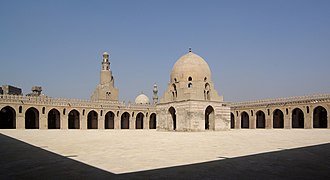
The Mosque of Ibn Tulun is a mosque in Islamic Cairo, Egypt. Built between 876 and 879 CE by its namesake, Ahmad ibn Tulun, it is the oldest well-preserved mosque in Egypt. Its design was inspired by the 9th-century mosques of Samarra in Iraq, the Abbasid capital at the time, making it an important representative of classical Abbasid architecture. It is one of the most significant monuments of Islamic architecture in Egypt.
Fusṭāṭ was the first capital of Egypt under Muslim rule, nowadays part of Cairo. It was built adjacent to what is now known as Old Cairo by the Rashidun Muslim general ʿAmr ibn ul-ʿĀṣ immediately after the Muslim conquest of Egypt in AD 641, and featured the Mosque of ʿAmr, the first mosque built in Egypt.
Al-Azhar Mosque, known in Egypt simply as al-Azhar, is a mosque in the historic Islamic core of the city of Cairo, Egypt. Commissioned as the new capital of the Fatimid Caliphate in 970 CE, it was the first mosque established in a city that eventually earned the nickname "the City of a Thousand Minarets". Its name is usually thought to derive from az-Zahrāʾ, a title given to Fatima, the daughter of Muhammad.
The Amr ibn al-As Mosque is a mosque, located in the Fustat neighbourhood of Old Cairo, Egypt. Named in honour of the Arab Muslim commander Amr ibn al-As, the mosque was built in c. 642 CE as the centre of the newly founded capital of Egypt, Fustat. The original structure was the first mosque built in Egypt and one of the first in Africa. For 600 years, the mosque was also an important centre of Islamic learning until it was replaced by al-Muizz's Al-Azhar Mosque in Islamic Cairo. Through the twentieth century, it was the fourth largest mosque in the Islamic world.
The Muhammad Ali Mosque, also known as the Mosque of Muhammad Ali, is a mosque located in the Citadel of Cairo, Egypt. It was commissioned by Muhammad Ali Pasha and built between 1832 and 1857. Overlooking the city, it is one of the most visible mosques and landmarks in the skyline of Cairo. Unlike the traditional Cairene architecture that preceded it, the mosque was built in an entirely Ottoman and European-influenced style, further setting it apart from other monuments. It is sometimes called the Alabaster Mosque due to the prominent use of alabaster as a covering for its walls.
The Cairo International Stadium, formerly known as Nasser Stadium, is an Olympic-standard, multi-use stadium with an all-seated capacity of 75,000. The architect of the stadium is the German Werner March, who designed the Olympic Stadium in Berlin from 1934 to 1936. The engineering and construction supervision of the stadium was performed by ACE Moharram Bakhoum. It is the 69th largest stadium in the world and the 3rd largest stadium in Egypt.
The Mosque-Madrasa of Sultan Hasan is a monumental mosque and madrasa located in Salah al-Din Square in the historic district of Cairo, Egypt. It was built between 1356 and 1363 CE during the Bahri Mamluk period, commissioned by Sultan an-Nasir Hasan. The mosque was considered remarkable for its massive size and innovative architectural components, and is still considered one of the most impressive historic monuments in Cairo today.
The al-Hakim Mosque, also known as al-Anwar, is a mosque in Cairo, Egypt. It is named after al-Ḥākim bi-Amr Allāh (985–1021), the 6th Fatimid caliph and 16th Ismāʿīlī Imam. Construction of the mosque was originally started by Caliph al-ʿAziz, the son of al-Muʿizz and the father of al-Ḥākim, in 990 CE. It was completed in 1013 by al-Ḥākim, which is why it is named after him.
Saint Virgin Mary's Coptic Orthodox Church, also known as the Hanging Church, is one of the oldest churches in Egypt which dates to the third century. It belongs to the Coptic Orthodox Church of Alexandria.
Places from Wikidata and Wikipedia.
Contains affiliate links.