Discover the best time of year, based on historical climate, temperature, and precipitation.
The best weather in Bahçelievler is from June, September, October. — consistent weather climate
🌥Mild
Contains affiliate links.
| Score | 17 | 29 | 32 | 64 | 86 | 87 | 79 | 80 | 88 | 89 | 60 | 32 |
|---|---|---|---|---|---|---|---|---|---|---|---|---|
| Climate | Cold | Cold | Cold | Mild | Mild | Pleasant | Pleasant | Hot & dry | Pleasant | Mild | Mild | Cold |
| Temperature | 5–10°C | 5–11°C | 5–12°C | 9–16°C | 13–21°C | 18–26°C | 21–30°C | 22–30°C | 19–26°C | 14–21°C | 10–16°C | 8–13°C |
| Feels like | 1–6°C | 1–7°C | 1–9°C | 6–15°C | 11–21°C | 19–27°C | 23–30°C | 24–31°C | 19–25°C | 13–19°C | 8–14°C | 5–10°C |
| Precipitation | 95mm 13 days | 71mm 11 days | 80mm 15 days | 75mm 11 days | 58mm 8 days | 51mm 8 days | 20mm 4 days | 15mm 3 days | 52mm 6 days | 41mm 7 days | 96mm 8 days | 87mm 13 days |
| Sunshine | 5.1h ☀︎ 54% | 6.9h ☀︎ 65% | 6.9h ☀︎ 58% | 9.4h ☀︎ 71% | 11.5h ☀︎ 80% | 12.9h ☀︎ 86% | 13.6h ☀︎ 92% | 12.6h ☀︎ 91% | 11.0h ☀︎ 89% | 8.6h ☀︎ 78% | 6.9h ☀︎ 70% | 5.0h ☀︎ 54% |
| Wind | NW · 25 km/h | NW · 25 km/h | N · 22 km/h | NE · 23 km/h | NE · 21 km/h | N · 21 km/h | NE · 25 km/h | NE · 25 km/h | NE · 24 km/h | NE · 21 km/h | NE · 24 km/h | NE · 23 km/h |
| Humidity (%) | 77% | 77% | 78% | 76% | 75% | 74% | 67% | 68% | 68% | 74% | 75% | 80% |
| Day length | 9.6h | 10.6h | 12.0h | 13.3h | 14.5h | 15.1h | 14.8h | 13.8h | 12.5h | 11.1h | 9.9h | 9.3h |
While standard climate charts point to October as Bahçelievler's meteorological peak, September delivers the true suburban sweet spot—pairing midsummer warmth with a sudden collapse in transit crowds.
Nobody arrives in Bahçelievler looking for Byzantine ruins or sweeping views of the Bosphorus. A dense, unapologetically middle-class municipality stretched along Istanbul's bustling European flank, it was named for 'houses with gardens,' though modern concrete, wide avenues, and busy commercial arteries long ago replaced the orchards. Travelers land here for everyday Turkish life, family ties, or convenient staging along the D.100 corridor just north of Bakırköy. Because the district moves to the rhythm of commuters and local families rather than sightseers, timing a visit comes down to when the concrete breathes easiest and the transit lines clear out.
On paper, October boasts the district's best pure weather score, but September is the month to actually be here. By the time September arrives, the intense midsummer pressure on transit interchanges and arterial streets simply vanishes. Foot traffic drops sharply as school terms resume and the summer exodus winds down, leaving the wide pedestrian avenues and neighborhood tea gardens unexpectedly calm.
The weather retains the golden generosity of late summer without the suffocating heat of July and August. Afternoon highs hover comfortably in the mid-twenties, and evening walks along neighborhood avenues like those branching off Şirinevler feel light and breezy. Occasional passing rain showers refresh the asphalt rather than wash out the day. It is the rare window when Bahçelievler feels unhurried, spacious, and distinctly livable.
October offers genuinely lovely walking conditions—crisp air, gentle sunshine, and lingering mildness that invites quiet afternoons lingering at outdoor neighborhood cafes. But by October, suburban bustle returns in full force, and foot traffic rebounds noticeably. If you want pristine autumn air without shivering, October will reward you, provided you do not mind sharing the pavements with hundreds of thousands of daily commuters.
November breaks the spell completely. The transition is sharp, marked by dense cloud cover and the heaviest rainfall intensity of the entire year. Downpours in November arrive in soaking, disruptive bursts that overwhelm sidewalks and clog the D.100 into endless tailbacks. Despite a strange uptick in visitors, the chill seeps through heavy coats, and outdoor life retreats indoors behind steam-fogged shop windows.
Winter in Bahçelievler is damp, raw, and thoroughly domestic. From December through February, temperatures rarely lift above single digits, made to feel substantially colder by biting winds blowing across the low European plateau. The sky hangs low and uniformly gray for weeks on end, with sunlight reduced to brief five-hour slivers between persistent drizzles.
January represents the climatic low point of the year, a month where outdoor wandering holds zero charm. The neighborhoods around Yenibosna and Şirinevler become pragmatic obstacle courses of cold drizzle and crowded bus shelters. March brings slightly longer days, but the damp cold lingers stubbornly, making early spring feel more like an extension of late winter than a true awakening. Come during these months only if personal business demands it, and pack woolens and a windproof coat.
April brings life back into the district's scattered pocket parks and the tree-lined avenues of inner Bahçelievler. The sun breaks through with authority, pushing daily temperatures into pleasant territory and coaxing residents onto park benches and bakery patios. But with the pleasant weather comes a swift surge in crowds; April and May see the district's transit hubs and shopping streets swell with heavy commuter and local foot traffic.
May is visually lush and reliably warm, reaching pleasant afternoon temperatures around twenty-one degrees. The days stretch out long and bright, ideal for wandering into neighboring Bakırköy or sitting out late over tea. The trade-off is friction: metro platforms are packed, crosswalks teem with shoulder-to-shoulder crowds, and securing an outdoor table requires patience.
Summer in Bahçelievler arrives with a pleasant respite in June, when crowd levels drop significantly even as temperatures rise into the mid-twenties. June days are sun-drenched and long, offering the best of the warm season before the urban heat island effect takes firm hold.
By late July and August, the district's high density works against it. Daily highs around thirty degrees bake the pavement, and the apparent temperature climbs past uncomfortable thresholds under unrelenting afternoon sun. August sees crowd levels peak, filling local shopping centers and arterial roads with thick traffic while the air remains stagnant and hot. Unless your trip revolves around air-conditioned interiors, midsummer in this concrete suburban basin is something to endure rather than savor.
Top sights and attractions to build your days around once you know when to go.
Hagia Sophia, officially the Hagia Sophia Grand Mosque, is a mosque and a major cultural and historical site in Istanbul, Turkey. It was formerly a church (360–1453) and a museum (1935–2020). The last of three church buildings to be successively erected on the site by the Eastern Roman Empire, it was completed in AD 537, becoming the world's largest interior space and among the first to employ a fully pendentive dome. It is considered the epitome of Byzantine architecture and is said to have "changed the history of architecture". From its dedication in 360 until 1453, Hagia Sophia served as the cathedral of Constantinople in the Byzantine liturgical tradition, except for the period 1204–1261 when the Latin Crusaders installed their own hierarchy. After the fall of Constantinople in 1453, it served as a mosque, having its minarets added soon after. The site became a museum in 1935, and was redesignated as a mosque in 2020.
Constantinople, the modern Istanbul, was the capital of the Roman and Byzantine Empire from 330 until its takeover by the Ottoman Empire in 1453. After this, it continued to function as the Ottoman capital Konstantiniyye until the abolition of the Ottoman sultanate in 1922. It was located at the core of the modern city of Istanbul, on a peninsula at the southeastern tip of Thrace in Europe; with the Bosporus strait and the ancient cities of Chalcedon and Chrysopolis in Bithynia, Anatolia to the east; the Golden Horn and the citadel of Galata (Pera) to the north; the Sea of Marmara to the south; and the Princes' Islands to the southeast.
The Sultan Ahmed Mosque, popularly known as the Blue Mosque, is an Ottoman-era historical imperial mosque located in Istanbul, Turkey. It was constructed between 1609 and 1617 during the rule of Ahmed I. It attracts a large number of tourists and is one of the most iconic and popular monuments of Ottoman architecture.
The Topkapı Palace or the Seraglio, is a large museum and library in the east of the Fatih district of Istanbul in Turkey. From the 1460s to the completion of Dolmabahçe Palace in 1853, it served as the administrative center of the Ottoman Empire, and was the main residence of its sultans.
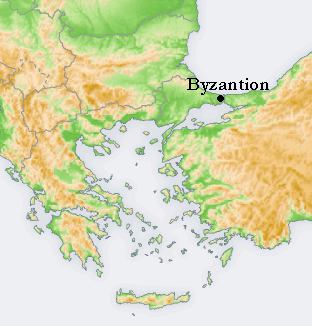
Byzantium or Byzantion was an ancient Greek city in classical antiquity that became known as Constantinople in late antiquity and Istanbul in modern times. The Greek name Byzantion and its Latinization Byzantium continued to be used as a name of Constantinople sporadically and to varying degrees during the thousand-year existence of the Eastern Roman Empire, which also became known by the former name of the city as the Byzantine Empire. Byzantium was colonised by Greeks from Megara in the 7th century BC and remained primarily Greek-speaking until its conquest by the Ottoman Empire in 1453.
The Süleymaniye Mosque is an Ottoman imperial mosque located on the Third Hill of Istanbul, Turkey. The mosque was commissioned by Suleiman the Magnificent and designed by the imperial architect Mimar Sinan. An inscription specifies the foundation date as 1550 and the inauguration date as 1557, although work on the complex probably continued for a few years after this.

The Galata Tower, officially the Galata Tower Museum, is a medieval Genoese tower in the Galata part of the Beyoğlu district of Istanbul, Turkey. Built as a watchtower at the highest point of the mostly demolished Walls of Galata, the tower is now an exhibition space and museum, and a symbol of Beyoğlu and Istanbul.
The Chora Church or Kariye Mosque was a Byzantine church, now converted to a mosque, in the Edirnekapı neighborhood of Fatih district, Istanbul, Turkey. It is famous for its outstanding Late Byzantine mosaics and frescos.
The Atatürk Olympic Stadium is a stadium in Istanbul, Turkey. Located in the western district of Başakşehir, it is the largest-capacity stadium in the country, and largest permanent track and field stadium outside Africa and Asia by capacity. The stadium is named after Mustafa Kemal Atatürk, the founder and first President of the Republic of Turkey. Its construction began in 1999 and was completed in 2002. It was originally built for Turkey's bid for the 2008 Olympic Games that were ultimately awarded to Beijing, China. It cost about US$140 million.
The Şehzade Mosque is a 16th-century Ottoman imperial mosque located in the district of Fatih, on the third hill of Istanbul, Turkey. It was commissioned by Suleiman the Magnificent as a memorial to his son Şehzade Mehmed who died in 1543. The mosque was one of the earliest and most important works of architect Mimar Sinan and is one of the signature works of Classical Ottoman architecture.
The New Mosque and later New Valide Sultan Mosque after its partial reconstruction and completion between 1660 and 1665, is an Ottoman imperial mosque located in the Eminönü quarter of Istanbul, Turkey. It is situated on the Golden Horn, at the southern end of the Galata Bridge, and is a notable Istanbul landmark marking the crossing from the old historic core of the city to the Beyoğlu (Pera) district. The mosque is a notable example of the Sultanate of Women period in Ottoman Empire.
The Basilica Cistern, or Cisterna Basilica, is the largest of several hundred ancient cisterns that lie beneath the city of Istanbul, Turkey. The cistern, located 150 metres (490 ft) southwest of the Hagia Sophia on the historical peninsula of Sarayburnu, was built in the 6th century during the reign of Byzantine emperor Justinian I. Today, it is kept with little water for public access inside the space.
Places from Wikidata and Wikipedia.
Contains affiliate links.