Things to do in Bağcılar
Top sights and attractions to build your days around once you know when to go.

Hagia Sophia
Hagia Sophia, officially the Hagia Sophia Grand Mosque, is a mosque and a major cultural and historical site in Istanbul, Turkey. It was formerly a church (360–1453) and a museum (1935–2020). The last of three church buildings to be successively erected on the site by the Eastern Roman Empire, it was completed in AD 537, becoming the world's largest interior space and among the first to employ a fully pendentive dome. It is considered the epitome of Byzantine architecture and is said to have "changed the history of architecture". From its dedication in 360 until 1453, Hagia Sophia served as the cathedral of Constantinople in the Byzantine liturgical tradition, except for the period 1204–1261 when the Latin Crusaders installed their own hierarchy. After the fall of Constantinople in 1453, it served as a mosque, having its minarets added soon after. The site became a museum in 1935, and was redesignated as a mosque in 2020.

Constantinople
Constantinople, the modern Istanbul, was the capital of the Roman and Byzantine Empire from 330 until its takeover by the Ottoman Empire in 1453. After this, it continued to function as the Ottoman capital Konstantiniyye until the abolition of the Ottoman sultanate in 1922. It was located at the core of the modern city of Istanbul, on a peninsula at the southeastern tip of Thrace in Europe; with the Bosporus strait and the ancient cities of Chalcedon and Chrysopolis in Bithynia, Anatolia to the east; the Golden Horn and the citadel of Galata (Pera) to the north; the Sea of Marmara to the south; and the Princes' Islands to the southeast.

Sultan Ahmed Mosque
The Sultan Ahmed Mosque, popularly known as the Blue Mosque, is an Ottoman-era historical imperial mosque located in Istanbul, Turkey. It was constructed between 1609 and 1617 during the rule of Ahmed I. It attracts a large number of tourists and is one of the most iconic and popular monuments of Ottoman architecture.

Topkapı Palace
The Topkapı Palace or the Seraglio, is a large museum and library in the east of the Fatih district of Istanbul in Turkey. From the 1460s to the completion of Dolmabahçe Palace in 1853, it served as the administrative center of the Ottoman Empire, and was the main residence of its sultans.
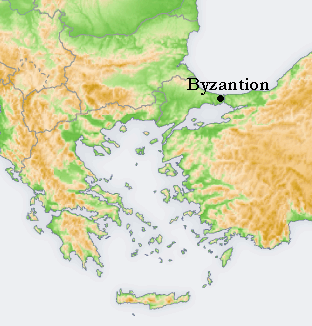
Byzantium
Byzantium or Byzantion was an ancient Greek city in classical antiquity that became known as Constantinople in late antiquity and Istanbul in modern times. The Greek name Byzantion and its Latinization Byzantium continued to be used as a name of Constantinople sporadically and to varying degrees during the thousand-year existence of the Eastern Roman Empire, which also became known by the former name of the city as the Byzantine Empire. Byzantium was colonised by Greeks from Megara in the 7th century BC and remained primarily Greek-speaking until its conquest by the Ottoman Empire in 1453.

Süleymaniye Mosque
The Süleymaniye Mosque is an Ottoman imperial mosque located on the Third Hill of Istanbul, Turkey. The mosque was commissioned by Suleiman the Magnificent and designed by the imperial architect Mimar Sinan. An inscription specifies the foundation date as 1550 and the inauguration date as 1557, although work on the complex probably continued for a few years after this.

Galata Tower
The Galata Tower, officially the Galata Tower Museum, is a medieval Genoese tower in the Galata part of the Beyoğlu district of Istanbul, Turkey. Built as a watchtower at the highest point of the mostly demolished Walls of Galata, the tower is now an exhibition space and museum, and a symbol of Beyoğlu and Istanbul.

Chora Church
The Chora Church or Kariye Mosque was a Byzantine church, now converted to a mosque, in the Edirnekapı neighborhood of Fatih district, Istanbul, Turkey. It is famous for its outstanding Late Byzantine mosaics and frescos.

Atatürk Olympic Stadium
The Atatürk Olympic Stadium is a stadium in Istanbul, Turkey. Located in the western district of Başakşehir, it is the largest-capacity stadium in the country, and largest permanent track and field stadium outside Africa and Asia by capacity. The stadium is named after Mustafa Kemal Atatürk, the founder and first President of the Republic of Turkey. Its construction began in 1999 and was completed in 2002. It was originally built for Turkey's bid for the 2008 Olympic Games that were ultimately awarded to Beijing, China. It cost about US$140 million.

Şehzade Mosque
The Şehzade Mosque is a 16th-century Ottoman imperial mosque located in the district of Fatih, on the third hill of Istanbul, Turkey. It was commissioned by Suleiman the Magnificent as a memorial to his son Şehzade Mehmed who died in 1543. The mosque was one of the earliest and most important works of architect Mimar Sinan and is one of the signature works of Classical Ottoman architecture.

New Mosque
The New Mosque and later New Valide Sultan Mosque after its partial reconstruction and completion between 1660 and 1665, is an Ottoman imperial mosque located in the Eminönü quarter of Istanbul, Turkey. It is situated on the Golden Horn, at the southern end of the Galata Bridge, and is a notable Istanbul landmark marking the crossing from the old historic core of the city to the Beyoğlu (Pera) district. The mosque is a notable example of the Sultanate of Women period in Ottoman Empire.

Basilica Cistern
The Basilica Cistern, or Cisterna Basilica, is the largest of several hundred ancient cisterns that lie beneath the city of Istanbul, Turkey. The cistern, located 150 metres (490 ft) southwest of the Hagia Sophia on the historical peninsula of Sarayburnu, was built in the 6th century during the reign of Byzantine emperor Justinian I. Today, it is kept with little water for public access inside the space.
Places from Wikidata and Wikipedia.
Contains affiliate links.