O que fazer em Weimar
Principais pontos turísticos e atrações para montar seus dias depois de saber quando ir.

Buchenwald
Buchenwald foi um campo de concentração nazista localizado no actual estado da Turíngia, no leste da Alemanha. Ficou em operação de 1937 a 1945, com 280 mil pessoas sendo aprisionadas no campo ao longo de sua existência. Cerca de 56 000 prisioneiros foram mortos em Buchenwald pelos alemães.

Bad Berka
Bad Berka é uma cidade da Alemanha localizada no distrito de Weimarer Land, estado da Turíngia.
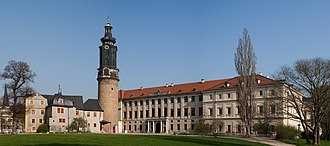
Palácio de Weimar

Haus am Horn
A Haus am Horn foi construída para a exposição Bauhaus em Weimar de 1923. Foi desenhada por Georg Muche, um pintor e professor na Bauhaus. Outros instrutores do Bauhaus, como Adolf Meyer e Walter Gropius, assistiram com os aspectos técnicos do desenho da casa. Gropius disse que o objetivo da construção da casa era "o maior conforto com a maior economia pela aplicação dos melhores artesãos e a melhor distribuição do espaço pela forma, tamanho e articulação". A construção da casa foi patrocinada por Sommerfeld, um negociante de madeira de Berlim, que tinha sido cliente de Gropius anos antes. A casa foi construída afastada da principal seção do Bauhaus, na terra que era usada como uma horta pela escola. O local fica atualmente perto do Parque an der Ilm em Weimar, numa rua residencial.

Schloss Belvedere
The Baroque palace Schloss Belvedere on the outskirts of Weimar, is a pleasure-house (Lustschloss) built for house-parties, built in 1724–1732 to designs of Johann August Richter and Gottfried Heinrich Krohne for Ernst August, Duke of Saxe-Weimar. The corps de logis is flanked by symmetrical pavilions. Today it houses part of the art collections of Weimar, with porcelains and faience, furniture and paintings of the eighteenth century. As the summer residence, its gardens, laid out in the French style in 1728–1748, were an essential amenity. A wing of the Orangery in the Schlosspark contains a collection of historical carriages.

St. Peter und Paul
The church of St Peter and Paul in Weimar, Germany, is also known as Herderkirche after Johann Gottfried Herder. It is the most important church building of the town, and is called Stadtkirche, opposed to the courtly Schloßkirche. It has been the church of a Lutheran parish since 1525, after the Reformation. The church is part of the World Heritage Site Classical Weimar, together with other sites affiliated with the Weimar Classicism movement. Inscribed on the World Heritage List in 1998, these sites bear testimony to the cultural importance of Weimar during the late 18th and 19th centuries and the outstanding architecture that arose in response to the cultural values of the time.

Bauhaus Museum, Weimar
The Bauhaus Museum Weimar is a museum dedicated to the Bauhaus design movement located in Weimar, Germany. It presents the Weimar collections of the State Bauhaus, which was founded in the town in 1919. The museum is a project of the Klassik Stiftung Weimar and is located near the Weimarhallenpark. Originally opened in 1995, it is now housed in a new building since April 2019.

Nietzsche-Archiv
O Arquivo Nietzsche é a primeira organização que se dedica a arquivar e documentar a vida e a obra do filósofo Friedrich Nietzsche, todas provenientes de Elisabeth Förster-Nietzsche, irmã do filósofo.

Capela Ortodoxa Russa (Weimar)
A Capela Ortodoxa Russa é uma capela funerária construída em Weimar em 1860 para a Grã-duquesa Maria Pavlovna da Rússia. Foi construído no cemitério histórico atrás do Weimarer Fürstengruft, ao qual está ligado por uma passagem subterrânea. O caixão de Maria Pavlovna está localizado na passagem, com o caixão de seu marido Charles Frederick colocado diretamente ao lado dele. Uma escada em espiral leva a outra conexão subterrânea com o Fürstengruft, embora agora esteja fechada por uma placa de metal.

Ettersburg Castle and Park
Schloss Ettersburg is a palace with its extended park near Weimar, Thuringia, Germany. It sits on the Ettersberg. From 1998 it has been part of the ensemble Klassisches Weimar, a World Heritage Site.

Park an der Ilm
The Park an der Ilm is a large Landschaftspark in Weimar, Thuringia. It was created in the 18th century, influenced by Johann Wolfgang von Goethe, and has not been changed much, preserving a park of the period. It forms part of the World Heritage Site "Classical Weimar along with other sites across Weimar bearing testimony to the city's historical importance as a cultural hub during the Weimar Classicism movement in the late 18th and 19th centuries".

Neues Museum Weimar
Locais do Wikidata e da Wikipédia.
Contém links de afiliado.