Things to do in Weimar
Top sights and attractions to build your days around once you know when to go.

Buchenwald concentration camp
Buchenwald was a German Nazi concentration camp established on Ettersberg hill near Weimar, Germany, in July 1937. It was one of the first and the largest of the concentration camps within the Altreich territories. Many actual or suspected communists were among the first internees.

Bad Berka
Bad Berka is a German spa town, situated in the south of Weimar region in the state of Thuringia. With its almost 8,000 inhabitants Bad Berka is the second biggest city in Weimarer Land district. The river flowing through the town, which is embedded in new red sandstone, is called Ilm. Since 1 December 2008, the city has incorporated the former municipality of Gutendorf.
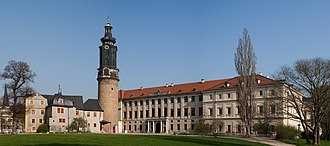
Schloss Weimar
Schloss Weimar is a Schloss (palace) in Weimar, Thuringia, Germany. It is now called Stadtschloss to distinguish it from other palaces in and around Weimar. The building is located at the north end of the town's park along the Ilm river, Park an der Ilm. It forms part of the World Heritage Site "Classical Weimar", along with other sites associated with Weimar's importance as a cultural hub during the late 18th and 19th centuries.

Haus am Horn
The Haus am Horn is a domestic house in Weimar, Germany, designed by Georg Muche. It was built for the Bauhaus Werkschau exhibition which ran from July to September 1923. It was the first building based on Bauhaus design principles, which revolutionized 20th century architectural and aesthetic thinking and practice.

Schloss Belvedere
The Baroque palace Schloss Belvedere on the outskirts of Weimar, is a pleasure-house (Lustschloss) built for house-parties, built in 1724–1732 to designs of Johann August Richter and Gottfried Heinrich Krohne for Ernst August, Duke of Saxe-Weimar. The corps de logis is flanked by symmetrical pavilions. Today it houses part of the art collections of Weimar, with porcelains and faience, furniture and paintings of the eighteenth century. As the summer residence, its gardens, laid out in the French style in 1728–1748, were an essential amenity. A wing of the Orangery in the Schlosspark contains a collection of historical carriages.

St. Peter und Paul
The church of St Peter and Paul in Weimar, Germany, is also known as Herderkirche after Johann Gottfried Herder. It is the most important church building of the town, and is called Stadtkirche, opposed to the courtly Schloßkirche. It has been the church of a Lutheran parish since 1525, after the Reformation. The church is part of the World Heritage Site Classical Weimar, together with other sites affiliated with the Weimar Classicism movement. Inscribed on the World Heritage List in 1998, these sites bear testimony to the cultural importance of Weimar during the late 18th and 19th centuries and the outstanding architecture that arose in response to the cultural values of the time.

Bauhaus Museum, Weimar
The Bauhaus Museum Weimar is a museum dedicated to the Bauhaus design movement located in Weimar, Germany. It presents the Weimar collections of the State Bauhaus, which was founded in the town in 1919. The museum is a project of the Klassik Stiftung Weimar and is located near the Weimarhallenpark. Originally opened in 1995, it is now housed in a new building since April 2019.

Nietzsche Archive
The Nietzsche Archive is the first organization that dedicated itself to archive and document the life and work of the philosopher Friedrich Nietzsche, all sourced from Elisabeth Förster-Nietzsche, the philosopher's sister.

Russian Orthodox Chapel
The Russian Orthodox Chapel is a funerary chapel built in Weimar in 1860 for Grand Duchess Maria Pavlovna of Russia. It was constructed in the Historical Cemetery behind the Weimarer Fürstengruft, to which it is connected by an underground passage. Maria Pavlovna's coffin is located in the passage, with her husband Charles Frederick's coffin placed directly beside it. A spiral staircase leads to another underground connection to the Fürstengruft, though this is now closed by a metal plate.

Ettersburg Castle and Park
Schloss Ettersburg is a palace with its extended park near Weimar, Thuringia, Germany. It sits on the Ettersberg. From 1998 it has been part of the ensemble Klassisches Weimar, a World Heritage Site.

Park an der Ilm
The Park an der Ilm is a large Landschaftspark in Weimar, Thuringia. It was created in the 18th century, influenced by Johann Wolfgang von Goethe, and has not been changed much, preserving a park of the period. It forms part of the World Heritage Site "Classical Weimar along with other sites across Weimar bearing testimony to the city's historical importance as a cultural hub during the Weimar Classicism movement in the late 18th and 19th centuries".

Neues Museum Weimar
Places from Wikidata and Wikipedia.
Contains affiliate links.