Things to do in Vatican City
Top sights and attractions to build your days around once you know when to go.

Colosseum
The Colosseum is an elliptical amphitheatre in the centre of the city of Rome, Italy, just east of the Roman Forum. It is the largest ancient amphitheatre ever built, and is the largest standing amphitheatre in the world. Construction began under the Emperor Vespasian in 72 and was completed in AD 80 under his successor and heir, Titus. Further modifications were made during the reign of Domitian. The three emperors who were patrons of the work are known as the Flavian dynasty, and the amphitheatre was named the Flavian Amphitheatre by later classicists and archaeologists for its association with their family name (Flavius).
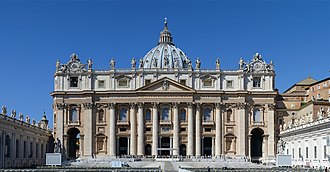
St. Peter's Basilica
The Papal Basilica of Saint Peter in the Vatican, or simply St. Peter's Basilica, is a church of the Italian Renaissance located in Vatican City, an independent microstate enclaved within the city of Rome, Italy. It was initially planned in the 15th century by Pope Nicholas V and then Pope Julius II to replace the ageing Old St. Peter's Basilica, which was built in the fourth century by Roman emperor Constantine the Great. Construction of the present basilica began on 18 April 1506 and was completed on 18 November 1626.

Sistine Chapel
The Sistine Chapel is a chapel in the Apostolic Palace, the pope's official residence in Vatican City. Originally known as the Cappella Magna, it takes its name from Pope Sixtus IV, who had it built between 1473 and 1481. Since that time, it has served as a place of both religious and functionary papal activity. Today, it is the site of the papal conclave, the process by which a new pope is selected. The chapel's fame lies mainly in the frescoes that decorate its interior, most particularly the Sistine Chapel ceiling and The Last Judgment, both by Michelangelo.

Pantheon
The Pantheon is an ancient temple in Rome, Italy, originally built under emperor Augustus and reconstructed under Hadrian (117–138); since AD 609, it is a Catholic church called the Basilica of St. Mary and the Martyrs. It is perhaps the most famous, and architecturally most influential, rotunda.

Stadio Olimpico
Stadio Olimpico, colloquially known as l'Olimpico, is an Italian multi-purpose sports venue located in Rome. Seating over 70,000 spectators, it is the largest sports facility in Rome and the second-largest in Italy, after Milan's San Siro. It formerly had a capacity of over 100,000 people, and was also called Stadio dei Centomila. It is owned by Sport e Salute, a government agency that manages sports venues, and its operator is the Italian National Olympic Committee.

Roman Forum
The Roman Forum, also known by its Latin name Forum Romanum, is a rectangular forum (plaza) surrounded by the ruins of several important ancient government buildings at the centre of the city of Rome. Citizens of the ancient city referred to this space, originally a marketplace, as the Forum Magnum, or simply the Forum.

Trevi Fountain
The Trevi Fountain is an 18th-century fountain in the Trevi district in Rome, Italy, designed by Italian architect Nicola Salvi and completed by Giuseppe Pannini in 1762. Standing 26.3 metres (86 ft) high and 49.15 metres (161.3 ft) wide, it is the largest Baroque fountain in the world and one of the most famous fountains in the world.

Vatican Museums
The Vatican Museums are the public museums of the Vatican City. They display works from the immense collection amassed by the Catholic Church and the papacy throughout the centuries, including several of the best-known Roman sculptures and most important masterpieces of Renaissance art in the world. The museums contain roughly 70,000 works, of which 20,000 are on display, and currently employ 640 people who work in 40 different administrative, scholarly, and restoration departments.

Palatine Hill
The Palatine Hill, which is the centremost of the seven hills of Rome, is one of the most ancient parts of the city; it has been called "the first nucleus of the Roman Empire". The site is now mainly a large open-air museum and the Palatine Museum houses many finds from the excavations here and from other ancient Italian sites.

Archbasilica of St. John Lateran
The Archbasilica of Saint John Lateran, commonly known as the Lateran Basilica or Saint John Lateran, is the Catholic cathedral of the Diocese of Rome in the city of Rome, Italy. It serves as the seat of the bishop of Rome and head of the worldwide Catholic Church: the pope. The only "archbasilica" in the world, it lies outside of Vatican City proper, which is located approximately four kilometres northwest. Nevertheless, as properties of the Holy See, the archbasilica and its adjoining edifices enjoy an extraterritorial status from Italy, pursuant to the terms of the Lateran Treaty of 1929. Dedicated to Christ the Saviour, in honor of John the Baptist and John the Evangelist, the place name – Laterano (Lateran) – comes from an ancient Roman family (gens), whose palace (domus) grounds occupied the site. The adjacent Lateran Palace was the primary residence of the pope until the Middle Ages.

Apostolic Palace
The Apostolic Palace is the official residence of the Pope, the head of the Catholic Church, located in Vatican City. It is also known as the Papal Palace, the Palace of the Vatican and the Vatican Palace. The Vatican itself refers to the building as the Palace of Sixtus V, in honor of Pope Sixtus V, who built most of the present form of the palace.

Castel Sant'Angelo
Castel Sant'Angelo, also known as Mausoleum of Hadrian, is a towering rotunda in Parco Adriano, Rome, Italy. It was initially commissioned by the Roman Emperor Hadrian as a mausoleum for himself and his family. The popes later used the building as a fortress and castle dedicated to Saint Michael the Archangel, and it is now a museum. The structure was once the tallest building in Rome.
Places from Wikidata and Wikipedia.
Contains affiliate links.