Things to do in Uppsala
Top sights and attractions to build your days around once you know when to go.

Uppsala Cathedral
Uppsala Cathedral is a cathedral located between the University Hall of Uppsala University and the Fyris river in the centre of Uppsala, Sweden. A church of the Church of Sweden, the national church, in the Evangelical-Lutheran tradition, Uppsala Cathedral is the seat of the Archbishop of Uppsala, the primate of Sweden. It is also the burial site of King Eric IX, who became the patron saint of the nation, and it was the traditional location for the coronation of new Kings of Sweden. The current archbishop is Martin Modéus and the current bishop is Karin Johannesson.

Gamla Uppsala
Gamla Uppsala is a parish and a village outside Uppsala in Sweden. It had 17,973 inhabitants in 2016.
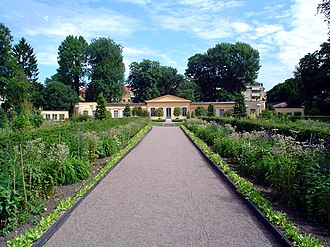
Linnaean Garden
The Linnaean Garden or Linnaeus Garden is the oldest of the botanical gardens belonging to Uppsala University, Sweden, and nowadays one of two satellite gardens of the larger University of Uppsala Botanic Garden, the other being the Linnaeus family's former summer home Linnaeus's Hammarby. The garden has been restored and is kept as an 18th-century botanical garden, according to the specifications of Carl Linnaeus, who started studying at Uppsala University in 1730 where he later became professor of botany and principal and is known for formalising the modern system of naming organisms, creating the modern binomial nomenclature, and who owned the garden from 1741 and had it rearranged according to his own ideas, documented in his work Hortus Upsaliensis (1748).

Stones of Mora
The Stones of Mora is a historic location in Knivsta, Sweden. Several Medieval kings of Sweden were proclaimed at the assembly of Mora near modern Uppsala. It was moved in the 15th century and was considered to have been lost. However, there are a number of stones of record in a small building in the vicinity of the former assembly site.

Uppsala Castle
Uppsala Castle is a 16th-century royal castle in the city of Uppsala, Sweden. Throughout much of its early existence, the castle played a major role in the history of Sweden. Originally constructed in 1549, the castle has been heavily remodeled, expanded, and otherwise modified. Today the structure houses the official residence of the governor of Uppsala County, various businesses, and museums.

Gustavianum
Gustavianum is the oldest standing building at Uppsala University. It was built between 1622 and 1625, and was used as the main building of the university between 1778 and 1887. Since 1997, it has been used as the university's museum.

Upsala-Lenna Jernväg
Upsala–Lenna Järnväg (ULJ), also nicknamed "Lennakatten", is a narrow-gauge heritage railway in Uppsala County, Sweden. It is 33 km (21 mi) long and is a part of the once extensive Roslagen narrow-gauge network. The gauge is the 891 mm, unique to Sweden. The railway is run by the society SRJmf.

Uppsala Mosque
The Uppsala Mosque is a small but very frequented mosque located in the Kapellgärdet neighbourhood of Uppsala in Sweden. At the time of construction, it was mistakenly claimed to be the northernmost mosque in the world. It is still the northernmost mosque in Sweden.

Valsgärde
Valsgärde or Vallsgärde is a farm on the Fyris river, about three kilometres north of Gamla Uppsala, the ancient centre of the Swedish kings and of the pagan faith in Sweden. The present farm dates from the 16th century. The farm's notability derives from the presence of a burial site, which was used for more than 300 years during the Swedish Vendel Age and the Viking Age. The first ship burial is from the 6th century and the last graves are from the 11th century.

Studenternas IP
Studenternas IP is a multi-use stadium in Uppsala, Sweden and the home arena for the football club IK Sirius Fotboll on the men's side and IK Uppsala Fotboll on the women's and in bandy for IK Sirius in Elitserien and several other bandy teams. It was inaugurated on 21 March 1909.

Linnaeus Hammarby
Linnaeus's Hammarby is a historic house museum and mansion, and one of three botanical gardens belonging to Uppsala University, located in Sweden. It is situated about ten kilometres (6.2 mi) southeast of Uppsala.

Uppsala Botanical Garden
The Botanical Garden of Uppsala University is the principal botanical garden in the city of Uppsala, Sweden. It is situated near to Uppsala Castle and belongs to Uppsala University, having been created on land donated to the university by King Gustav III in 1787; it is now open to the public alongside the university's other botanical gardens, the Linnaean Garden and Linnaeus Hammarby, as well with a museum on site. The original Botanical Garden was founded in 1655 by Olaus Rudbeck, making it the oldest botanical garden in Sweden. Having been damaged in the 1702 Uppsala fire, it fell into neglect before it was redesigned and renovated by Carl Linnaeus, a professor at the university. Under the leadership of Linnaeus, the garden's collection grew massively and it became one of the most prominent botanical gardens in the world. The original site is maintained by Uppsala University to Linnaeus' recorded design to this day.
Places from Wikidata and Wikipedia.
Contains affiliate links.