Things to do in Turin
Top sights and attractions to build your days around once you know when to go.

Juventus Stadium
Juventus Stadium, known for sponsorship reasons as the Allianz Stadium since July 2017, sometimes simply known in Italy as the Stadium, is an all-seater football stadium in the Vallette borough of Turin, Italy, and the home of Juventus. The stadium was built on the site of its former ground, the Stadio delle Alpi in the latter 2000s, and is the first club-owned football modern venue in the country. It is also one of only four stadiums in Italy accredited with the UEFA Category 4, which have the highest technical level in the confederation's Stadium Infrastructure Regulations, alongside the San Siro, the Stadio Olimpico di Roma and the Stadio Olimpico Grande Torino. It was opened at the start of the 2011–12 season and, with 41,689 spectators, it is the sixth largest football stadium in Italy by seating capacity, as well the first in Piedmont.

Museo Egizio
The Museo Egizio or Egyptian Museum is an archaeological museum in Turin, Italy, specializing in Egyptian archaeology and anthropology. It houses one of the largest collections of Egyptian antiquities, with more than 40,000 artifacts, which is considered the second most important Egyptological collection in the world after the one at the Egyptian Museum of Cairo. Founded in 1824 by King Charles Felix, it is the world's oldest museum dedicated entirely to ancient Egyptian culture. In 2024, it received 1,036,689 visitors, making it one of the most visited museums in Italy.
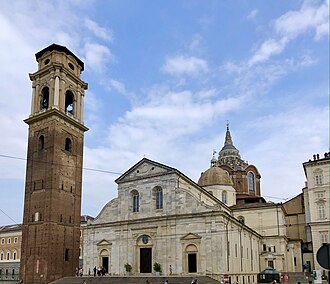
Turin Cathedral
Turin Cathedral or Cathedral of Saint John the Baptist is a Roman Catholic cathedral in Turin, northern Italy. Dedicated to Saint John the Baptist. It is the seat of the Archbishops of Turin.

Mole Antonelliana
The Mole Antonelliana is a major landmark building in Turin, Italy, named after its architect, Alessandro Antonelli. A mole in Italian is a building of monumental proportions.

Basilica of Superga
The Basilica of Superga is a hilltop Catholic basilica in Superga, in the vicinity of Turin, Italy.

Royal Palace of Turin
The Royal Palace of Turin is a historic palace of the House of Savoy in the city of Turin in Northern Italy. It was originally built in the 16th century and was later modernized by Christine Marie of France (1606–1663) in the 17th century, with designs by the Baroque architect Filippo Juvarra. The palace also includes the Palazzo Chiablese and the Chapel of the Holy Shroud, the latter of which was built to house the famous Shroud of Turin.

Palazzina di caccia of Stupinigi
The Palazzina di caccia of Stupinigi is one of the Residences of the Royal House of Savoy in the Metropolitan City of Turin in northern Italy, part of the UNESCO World Heritage Sites list. Built as a royal hunting lodge in the early 18th century, it is located in Stupinigi, a suburb of the town of Nichelino, 10 km (6 mi) southwest of Turin.

Palazzo Carignano
Palazzo Carignano is a historical building in the centre of Turin, Italy, which houses the Museum of the Risorgimento. It was a private residence of the Princes of Carignano, after whom it is named. Its rounded façade is different from other façades of the same structure. It is located on the Via Accademia delle Scienze.

Palazzo Madama and Casaforte degli Acaja, Turin
Palazzo Madama is a palace in Turin, Piedmont. It was the first Senate of the Kingdom of Italy, and takes its traditional name from the embellishments it received under two queens (madama) of the House of Savoy.

Palace of Venaria
The Palace of Venaria is a former royal residence and gardens located in Venaria Reale, near the city of Turin in the Piedmont region in northern Italy. It is one of the 14 Residences of the Royal House of Savoy built in the area between the 16th and 18th centuries which were collectively designated a UNESCO World Heritage Site in 1997.

Galleria Sabauda
The Savoy Gallery is an art collection in the Italian city of Turin, which contains the royal art collections amassed by the House of Savoy over the centuries. It is located on Via XX Settembre, 86.

Castello del Valentino
The Valentino Castle is a historic building in the northwestern Italian city of Turin. It is located in Parco del Valentino, and is the seat of the Architecture Faculty of the Polytechnic University of Turin. It is one of the Residences of the Royal House of Savoy included in the list of UNESCO World Heritage Sites in 1997.
Places from Wikidata and Wikipedia.
Contains affiliate links.