Discover the best time of year, based on historical climate, temperature, and precipitation.
The best time to visit Trondheim is June, July, August, when the weather, flight prices, and crowds align. — variable climate
🌨Cold
Contains affiliate links.
| Score | 8 | 10 | 12 | 20 | 44 | 67 | 73 | 67 | 44 | 9 | 9 | 7 |
|---|---|---|---|---|---|---|---|---|---|---|---|---|
| Climate | Polar | Polar | Cold | Cold | Cold | Mild | Cool & rainy | Cool & rainy | Cold | Cold | Cold | Polar |
| Temperature | -5–0°C | -4–1°C | -2–4°C | 0–8°C | 5–13°C | 9–17°C | 11–18°C | 11–18°C | 8–14°C | 4–9°C | -1–4°C | -3–1°C |
| Feels like | -9–-4°C | -8–-3°C | -7–0°C | -4–4°C | 2–11°C | 7–15°C | 10–17°C | 9–17°C | 6–13°C | 0–6°C | -5–0°C | -7–-3°C |
| Precipitation | 109mm 16 days | 86mm 14 days | 91mm 16 days | 80mm 14 days | 74mm 16 days | 96mm 16 days | 109mm 16 days | 129mm 16 days | 139mm 16 days | 135mm 18 days | 95mm 15 days | 124mm 16 days |
| Sunshine | 1.5h ☀︎ 25% | 3.3h ☀︎ 38% | 5.7h ☀︎ 48% | 8.9h ☀︎ 59% | 10.2h ☀︎ 56% | 9.6h ☀︎ 47% | 9.5h ☀︎ 49% | 8.6h ☀︎ 53% | 6.0h ☀︎ 46% | 4.2h ☀︎ 42% | 2.2h ☀︎ 32% | 0.7h ☀︎ 14% |
| Wind | S · 19 km/h | S · 18 km/h | S · 19 km/h | W · 17 km/h | NW · 17 km/h | NW · 17 km/h | NW · 16 km/h | W · 16 km/h | S · 17 km/h | S · 17 km/h | SE · 17 km/h | S · 17 km/h |
| Humidity (%) | 77% | 76% | 75% | 74% | 73% | 75% | 78% | 80% | 81% | 84% | 81% | 80% |
| Perfect days | 0% | 0% | 0% | 1% | 11% | 16% | 23% | 21% | 6% | 0% | 0% | 0% |
| Dry streak | 9d | 7d | 7d | 8d | 7d | 6d | 6d | 5d | 6d | 7d | 8d | 7d |
| Sunny streak | 1d | 4d | 8d | 12d | 14d | 10d | 12d | 10d | 7d | 6d | 2d | 0d |
| Extreme cold | 80% | 86% | 76% | 52% | 10% | — | — | — | 1% | 18% | 61% | 80% |
| Temperature | +1.1° | +2.2° | +2.2° | -1.3° | +0.3° | +1.6° | -2.1° | -0.9° | +0.2° | +0.8° | +1.0° | +1.1° |
| Rainfall | Stable | Stable | Getting wetter | Stable | Stable | Stable | Getting wetter | Getting wetter | Stable | Getting wetter | Stable | Stable |
| Ideal warm days | 0% | 0% | 0% | 0% | 1% | 3% | 7% | 1% | 0% | 0% | 0% | 0% |
| Outdoor comfort | 0% | 0% | 0% | 0% | 12% | 19% | 28% | 26% | 10% | 0% | 0% | 0% |
| Dry week odds | 16% | 9% | 8% | 10% | 6% | 4% | 5% | 2% | 5% | 6% | 10% | 8% |
| Heavy rain | 1% | 2% | 2% | — | — | 2% | 1% | 2% | 3% | 1% | 2% | 3% |
| Snow days | 55% | 56% | 52% | 34% | 12% | — | — | — | 1% | 14% | 32% | 52% |
| Day length | 5.8h | 8.7h | 11.8h | 15.0h | 18.2h | 20.4h | 19.2h | 16.2h | 13.0h | 9.8h | 6.7h | 4.7h |
| Tourist Crowds | Low season | Low season | Low season | Low season | Shoulder season | High season | High season | High season | Shoulder season | Low season | Low season | Low season |
This major cultural and religious festival celebrates Norway's patron saint, St. Olav, with concerts, historical markets…
The Trondheim Christmas Market transforms the city center into a festive wonderland with traditional stalls, local craft…
The Trondheim Jazz Festival showcases a wide range of jazz artists, from international stars to local talents, across va…
Kosmorama is Trondheim's international film festival, showcasing a diverse program of films from around the world, inclu…
Pstereo is one of Norway's largest outdoor music festivals, held on the beautiful Marinen park by the Nidelva river. In…
Trondheim Calling is a significant music industry festival and showcase for new Norwegian artists, attracting profession…
The Trondheim Marathon offers various distances, including a full marathon, half marathon, and 10K, with a scenic route…
This charming local festival celebrates the historic Bakklandet district with live music, street performances, local foo…
Trondheim sees its biggest crowds of the year in December, when the sun barely scrapes above the horizon for forty minutes a day, while July delivers luminous midnight skies and the year's warmest weather to a city that is practically uncrowded.
Trondheim was Norway's first capital, founded in 997 on the sheltered curve where the Nidelva meets the cold expanse of the Trondheim Fjord. For centuries, pilgrims walked hundreds of miles across Scandinavia to kneel inside Nidaros Cathedral, the northernmost medieval stone cathedral in the world. Today, the city balances its monumental Viking and ecclesiastical past against the hum of a premier university town. Wooden storehouses painted in ochre and rust stand on stilts over the river, framed by water and spruce-covered hills. Yet visiting Trondheim requires understanding an extraordinary calendar paradox: travelers flood the city when it is darkest and coldest, leaving its most glorious, sun-drenched weeks wide open.
Midsummer in Trondheim is an intoxicating, leisurely affair. The sun dips briefly toward the fjord around midnight without ever extinguishing the glow, casting long copper shadows across the riverbanks. Daily highs hover around 18 degrees, the air feels mild, and life moves outdoors onto the cobbles of Bakklandet, where timber houses host open-air tables and bicycle bells ring against the wooden planks of old bridges.
July is the undisputed peak of the calendar. The weather reaches its absolute finest, yet tourist density is barely half what the city endures during the holiday rush. You can wander along the Nidelva or attend the historical markets and open-air choral services of Olavsfestdagene without jostling shoulders. In June, the neighborhood comes alive during the Bakklandet Street Festival, while August brings the Pstereo Festival to the sprawling riverside lawn of Marinen, right beneath the looming silhouette of the cathedral. Late August brings heavier rains, but the sheer volume of daylight more than compensates.
September starts with crisp mornings and spectacular golden foliage that reflects off the fjord waters. Runners pack the streets for the Trondheim Marathon, thriving in the cool, bracing air. But autumn here belongs to moisture. By mid-September, the rain intensifies from gentle northern mist into persistent showers that roll off the North Atlantic.
October is bleak and rapidly darkening. Temperatures drop toward single digits, daily sunshine collapses to a brief afternoon window, and the city retreats indoors behind candlelight and heavy wool. Unless you are drawn specifically to misty, melancholy Nordic harbor scenes, October offers little comfort for roaming the waterfront.
December is Trondheim's most crowded month of the entire year, defying every conventional rule of travel. The sun provides less than an hour of weak daylight per day, apparent temperatures sit steadily below freezing, and sleet or snow coats the stone streets. Yet visitors pour in for the Trondheim Christmas Market, which blankets the central square in wooden chalets, open fire pits, and steaming cups of spiced drinks. The atmosphere around Nidaros Cathedral is undeniably cinematic, but you are trading daylight and comfort for sheer festive ambiance.
Once the holiday decorations come down, January settles in with bitter quiet. The cold deepens, apparent temperatures sink further, and the crowds vanish completely. It is a time of pure polar stillness—atmospheric if you crave solitude, but demanding thermal layers for even the shortest walk along the Nidelva.
February remains sharply cold and snowy, but the city shrugs off the winter slumber indoors with Trondheim Calling, when dozens of indie acts fill clubs across the center. By March, daylight explodes outward, gaining hours each week, though snowbanks still line the pavements. Kosmorama, the international film festival, takes advantage of this lingering chill, filling cozy cinemas while winter gives its last gasp.
April and May present a fascinating illusion. May delivers ten hours of sunshine a day—more than any other month—and the sky above the Trondheim Fjord can be piercingly clear. Around town, brass and saxophone notes drift into the streets during the Trondheim Jazz Festival. But do not mistake brightness for warmth. May winds blowing off the snowy inland plateau keep the apparent temperature around 10 degrees. It is an exhilarating, brisk season for walking, provided your jacket stays firmly zipped.
Top sights and attractions to build your days around once you know when to go.
Nidaros Cathedral is a Church of Norway cathedral located in the city of Trondheim in Trøndelag county. It is built over the burial site of King Olav II, who brought Christianity to Norway and became the patron saint of the nation; the consecration of new Norwegian monarchs occurs at Nidaros Cathedral. It was built over a 230-year period, from 1070 to 1300 when it was substantially completed. However additional work, additions and renovations have continued intermittently since then, including a major reconstruction starting in 1869 and completed in 2001. Nidaros Cathedral is a popular place of Evangelical-Lutheran Christian pilgrimage, with several thousand pilgrims visiting it each year. Mass and the Divine Office, according to the Evangelical-Lutheran tradition, are celebrated daily at Nidaros Cathedral, in addition to other prayer services that are held there throughout the day.
The Lerkendal Stadion is an all-seater association football stadium located at Lerkendal in Trondheim, Norway. The home ground of the Eliteserien (2017) side Rosenborg BK, it has a capacity for 21,405 spectators, making it the second-largest football stadium in the country.
Haltdalen Stave Church is a stave church that was originally built in the 1170s in the village of Haltdalen in what is now Holtålen Municipality in Trøndelag county, Norway. The church is now on display at the Sverresborg Trøndelag Folkemuseum in the city of Trondheim. This is a single-nave stave church of the east Scandinavian-style, and it is the only one that is preserved.
The Trondheim Synagogue is a Jewish congregation and synagogue, located at Arkitekt Christies gate 1B, in Trondheim, Norway. Established as a congregation in June 1892, the present synagogue has served the Jewish community since its inauguration on October 13, 1925. It was built to replace the first synagogue in Trondheim, the St Jørgensveita Synagogue, which was opened in 1899.
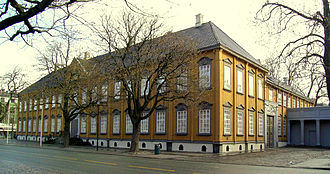
Stiftsgården is the royal residence in Trondheim, Norway. It is centrally situated on the city’s most important thoroughfare, Munkegaten. At 140 rooms constituting 4000 m² (43000 ft²), it is one of the largest wooden buildings in Northern Europe, and it has been used by royalty and their guests since 1800.
Ringve Museum is Norway's national museum for music and musical instruments, with collections from all over the world.
Granåsen is a ski jumping hill, located in Granåsen Ski Centre in Trondheim, Norway. The hill frequently hosts World Cup and Continental Cup competitions arranged by FIS and also hosted the FIS Nordic World Ski Championships 1997. The hill sports one normal sized hill (K-93) and one large hill (K-124).
The St. Olav's Cathedral is the church home to the Prelature of Trondheim, belonging to the Catholic Church in Norway.
The NTNU University Museum in Trondheim is one of seven Norwegian university museums with natural and cultural history collections and exhibits. The museum has research and administrative responsibility over archaeology and biology in Central Norway. Additionally, the museum operates comprehensive community outreach programs and has exhibits in wooden buildings in Kalvskinnet.

Lade Church is one of Norway's oldest existing stone churches. It is a parish church of the Church of Norway in Trondheim Municipality in Trøndelag county, Norway. It is located in the Lade neighborhood in the city of Trondheim, just southeast of Korsvika and east of Ladehammeren. It is the church for the Lade parish which is part of the Nidaros domprosti (arch-deanery) in the Diocese of Nidaros. The white, plastered stone church was built in a long church style around the year 1160. The church seats about 160 people.
Vår Frue Church is a medieval parish church of the Church of Norway in Trondheim Municipality in Trøndelag county, Norway. It is located in the downtown Midtbyen area of the city of Trondheim, just a few blocks north of the Nidaros Cathedral. It is one of the two churches for the Nidaros og Vår Frue parish which is part of the Nidaros domprosti (arch-deanery) in the Diocese of Nidaros. The gray, stone church was built in a long church design in the late 1100s using plans drawn up by Bjørn Sigvardsson. The church seats about 540 people.
The Trondheim Art Museum is an art museum located in Trondheim in Sør-Trøndelag county, Norway. The museum shows temporary exhibitions of international and regional art in dialogue with works from the museum's collection. The museum possesses Norway's third largest public art collection with an emphasis on art since 1850. The permanent collection contains iconic works such as Harald Sohlberg's Natt (1904), Georg Jacobsen's Haren (1922), and Peder Balke's Nordkapp (1870s).
Places from Wikidata and Wikipedia.
Contains affiliate links.