Discover the best time of year, based on historical climate, temperature, and precipitation.
The best time to visit San Francisco is July, August, September, when the weather, flight prices, and crowds align. — predictable climate
🌥Mild
Contains affiliate links.
| Score | 42 | 53 | 52 | 71 | 78 | 94 | 97 | 98 | 97 | 94 | 70 | 40 |
|---|---|---|---|---|---|---|---|---|---|---|---|---|
| Climate | Cold | Cold | Mild | Mild | Mild | Mild | Mild | Mild | Mild | Mild | Mild | Cold |
| Temperature | 8–14°C | 8–15°C | 9–15°C | 10–16°C | 11–17°C | 13–19°C | 13–19°C | 14–20°C | 14–21°C | 13–21°C | 10–16°C | 8–13°C |
| Feels like | 5–12°C | 5–12°C | 6–13°C | 7–14°C | 9–15°C | 10–18°C | 11–18°C | 13–19°C | 13–20°C | 12–19°C | 8–14°C | 5–11°C |
| Precipitation | 124mm 9 days | 89mm 8 days | 94mm 10 days | 34mm 5 days | 17mm 3 days | 1mm 1 days | 1mm 0 days | 1mm 0 days | 3mm 1 days | 29mm 3 days | 59mm 6 days | 129mm 10 days |
| Sunshine | 6.6h ☀︎ 66% | 8.9h ☀︎ 82% | 9.4h ☀︎ 79% | 11.4h ☀︎ 86% | 12.7h ☀︎ 89% | 13.3h ☀︎ 90% | 13.1h ☀︎ 91% | 12.3h ☀︎ 91% | 11.4h ☀︎ 92% | 9.8h ☀︎ 88% | 8.5h ☀︎ 83% | 6.6h ☀︎ 69% |
| Wind | NE · 22 km/h | NW · 24 km/h | W · 25 km/h | W · 27 km/h | W · 29 km/h | SW · 30 km/h | SW · 28 km/h | SW · 27 km/h | W · 26 km/h | W · 23 km/h | NW · 20 km/h | N · 20 km/h |
| Humidity (%) | 83% | 78% | 79% | 78% | 77% | 76% | 80% | 81% | 77% | 74% | 77% | 81% |
| Perfect days | 2% | 7% | 10% | 14% | 23% | 46% | 54% | 57% | 60% | 46% | 15% | 0% |
| Dry streak | 14d | 14d | 12d | 16d | 22d | 26d | 28d | 31d | 24d | 20d | 14d | 10d |
| Sunny streak | 14d | 17d | 17d | 22d | 26d | 27d | 31d | 31d | 29d | 24d | 15d | 11d |
| Extreme heat | — | — | — | — | — | — | — | — | 1% | 1% | — | — |
| Extreme cold | 1% | — | — | — | — | — | — | — | — | — | — | 1% |
| Temperature | +0.2° | +0.3° | -1.6° | -1.4° | -1.7° | -2.5° | -3.4° | -2.1° | -2.1° | +0.6° | -1.0° | +0.6° |
| Rainfall | Stable | Stable | Getting wetter | Stable | Stable | Stable | Stable | Stable | Stable | Stable | Getting wetter | Much wetter |
| Ideal warm days | 0% | 0% | 0% | 2% | 3% | 7% | 4% | 5% | 13% | 9% | 0% | 0% |
| Outdoor comfort | 1% | 11% | 17% | 22% | 26% | 47% | 60% | 63% | 62% | 52% | 18% | 1% |
| Dry week odds | 33% | 36% | 28% | 43% | 66% | 86% | 93% | 99% | 84% | 64% | 37% | 20% |
| Heavy rain | 6% | 4% | 3% | 1% | — | — | — | — | — | 1% | 2% | 5% |
| Day length | 9.9h | 10.8h | 12.0h | 13.2h | 14.2h | 14.7h | 14.5h | 13.6h | 12.4h | 11.2h | 10.1h | 9.6h |
| Tourist Crowds | Low season | Low season | Shoulder season | High season | High season | High season | High season | High season | High season | High season | High season | High season |
One of the world's largest and oldest LGBTQ+ Pride events, culminating in a huge parade down Market Street. June offers…
This iconic 12K footrace from the Bay to the Pacific Ocean is famous for its costumed participants and festive atmospher…
Celebrates the U.S. Navy, Marine Corps, and Coast Guard with ship tours and a spectacular air show featuring the Blue An…
The world's largest leather and BDSM event, attracting a diverse crowd to the South of Market district. September typica…
A beloved free music festival in Golden Gate Park, featuring a wide array of folk, bluegrass, and Americana artists. Oct…
A major music, food, and arts festival held in Golden Gate Park. While August is peak summer, San Francisco's 'summer fo…
San Francisco hosts one of the largest Lunar New Year celebrations outside Asia, culminating in a spectacular night para…
A vibrant street fair celebrating the LGBTQ+ community in the historic Castro district. Enjoy pleasant autumn weather an…
The largest free jazz festival on the West Coast, transforming Fillmore Street into a vibrant street fair. Enjoy warm, s…
San Francisco delivers its sunniest, driest, and most magnificent weather between July and October, yet visitors pour into the city at their absolute peak in November just as the winter rains arrive.
San Francisco is a city forged by dramatic geography, rising over steep hills squeezed between the Pacific Ocean and a massive bay. Born from an indigenous Yelamu Ohlone homeland, founded as a Spanish mission and military outpost, and thrust into global prominence by the Gold Rush, it remains one of the densest and most visually striking urban enclaves in North America. To experience it properly, you must walk its ridgelines and inhabit its streets. Doing so, however, requires understanding a microclimate that often defies mainland expectations. While late autumn draws the biggest crowds, the city is undeniably at its absolute best when summer settles into early autumn, bathing the hills in sustained warmth and brilliant maritime light.
Late summer into early autumn is the glorious heart of the San Francisco year. While much of the country endures oppressive humidity, this peninsula locks into weeks of luminous, crisp sunshine and virtually zero rainfall. In July, a curious lull in visitor density makes exploring remarkably easy. You can wander through the Fillmore District during the Fillmore Jazz Festival or meander past the pastel Victorian facades surrounding Alamo Square without battling wall-to-wall foot traffic.
By August and September, the warmth reaches its apex. Evenings remain pleasantly mild, though the marine layer can still slip over the western ridgelines at dusk, demanding a knit sweater. Golden Gate Park vibrates with the massive energy of the Outside Lands Music and Arts Festival in August, drawing thousands across the Panhandle into sunlit meadows. In September, the South of Market neighborhood turns electric with the leather-clad revelry of the Folsom Street Fair, soaking up the warmest afternoons of the calendar.
October extends this streak of immaculate weather. The skies remain deep blue, perfect for looking out over the Bay from the heights of Pacific Heights or Nob Hill. Golden Gate Park welcomes massive, easygoing crowds for the free melodies of Hardly Strictly Bluegrass, while the Castro District bursts with neighborhood pride during the Castro Street Fair. Fleet Week sends naval aircraft roaring over the Financial District and Russian Hill, capping off a four-month stretch where being outside is not just comfortable, but intoxicating.
November presents the grandest paradox of the local calendar. Statistically, it is the single most crowded month of the year, packing the sidewalks of Union Square and the shopping corridors around Lower Nob Hill to capacity. Yet this surge coincides precisely with the unraveling of the good weather.
The warmth of early autumn vanishes quickly as Pacific fronts begin tracking across northern California. Rain returns in steady, frequent increments, sweeping through the concrete canyons of the Financial District and splashing along the asphalt of Mission Bay. The ambient air turns sharply damp and cool, stripping the joy from outdoor promenades. If you arrive now, you will pay top dollar and wait in long lines for cable cars, all while ducking into doorways to escape sudden showers.
Winter in San Francisco is defined by ocean moisture. Between December and March, heavy Pacific storms roll across the peninsula, dumping the vast majority of the city's annual rainfall. December is the dampest and coldest stretch of all; winds whip across Rincon Hill and the avenues of the Sunset District feel drenched and exposed.
Still, winter is not a lost cause if you prefer cultural immersion over hill hiking. The gloom breaks periodically to yield washed-clean air of extraordinary clarity, where views from Potrero Hill across downtown are sharper than at any other time of year. Chinatown and the surrounding blocks of Lower Haight and Duboce Triangle roar to life during late January or February for the Chinese New Year Parade & Festival, filling the wet streets with firecrackers, drumming, and vibrant dancing dragons. Just come armed with a waterproof shell and plans centered around cafes in Hayes Valley or the tucked-away noodle shops of Japantown.
Spring arrives with a noticeable lightening of the atmosphere. By April, the winter storm track has retreated northward, the rain tapers off rapidly, and the sun shines with increasing vigor. The green spaces in the Richmond District and the steep parklets of Noe Valley flush with fresh growth, and walking between neighborhoods becomes an unmitigated joy.
May brings rising temperatures and the spirited lunacy of Bay to Breakers, a legendary footrace that sends tens of thousands in eccentric costumes sprinting and stumbling from the bayfront all the way through the Haight-Ashbury corridor to the western coast. It is a raucous showcase of the city's countercultural DNA, though it reliably snarls transit across the Western Addition.
June delivers long, sunlit days and virtually nonexistent precipitation. The energy builds toward the end of the month, when the historic San Francisco Pride Parade & Celebration draws immense, jubilant crowds along Market Street through the Civic Center. Days are bright and breezes are fresh, marking the threshold of the best season of the year.
Top sights and attractions to build your days around once you know when to go.
Golden Gate Park is an urban park between the Richmond and Sunset districts on the West Side of San Francisco, California, United States. It is the largest urban park in the city, containing 1,017 acres (412 ha), and the third-most visited urban park in the United States, with an estimated 24 million visitors annually. Part of the natural area is old-growth forest and recognized by the Old-Growth Forest Network.
The San Francisco Museum of Modern Art (SFMOMA) is a modern and contemporary art museum and nonprofit organization located in San Francisco, California. SFMOMA was the first museum on the West Coast devoted solely to 20th-century art, and has built an internationally recognized collection with over 33,000 works of painting, sculpture, photography, architecture, design, and media arts. The collection is displayed in 170,000 square feet (16,000 m2) of exhibition space, making the museum one of the largest in the United States overall, and one of the largest in the world for modern and contemporary art. In 2024, SFMOMA was ranked 14th in The Washington Post's list of the best art museums in the U.S.
Lombard Street is an east–west street in San Francisco, California, that has a steep, one-block section with eight hairpin turns. The street stretches from The Presidio east to The Embarcadero. Most of Lombard Street's western segment is a major thoroughfare designated as part of U.S. Route 101. The one-block section, claimed to be "the crookedest street in the world", is located along the eastern segment in the Russian Hill neighborhood. It is a major tourist attraction, receiving around two million visitors per year and up to 17,000 per day on busy summer weekends, as of 2015.
United States Penitentiary, Alcatraz Island, also known simply as Alcatraz or The Rock, was a maximum security federal prison on Alcatraz Island, 1.25 miles (2.01 km) off the coast of San Francisco, California, United States. The site of a fort since the 1850s, the main prison building was built from 1910 to 1912 as a U.S. Army military prison.
USS Hornet (CV/CVA/CVS-12) is an Essex-class aircraft carrier built for the United States Navy (USN) during World War II. Completed in late 1943, the ship was assigned to the Fast Carrier Task Force in the Pacific Ocean, the navy's primary offensive force during the Pacific War. The ship was also used to recover the Apollo 11 and Apollo 12 crews.
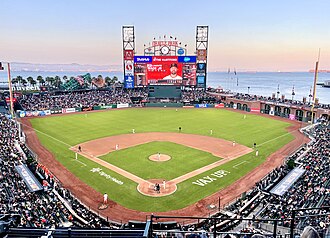
Oracle Park is a ballpark in the South Beach neighborhood of San Francisco, California, United States. Since 2000, it has been the home of the San Francisco Giants of Major League Baseball (MLB). The stadium stands along San Francisco Bay; the section of the bay beyond Oracle Park's right field wall is unofficially known as McCovey Cove, in honor of former Giants player Willie McCovey. Previously named Pacific Bell Park, SBC Park, and AT&T Park, the stadium's existing name was purchased by Oracle Corporation in 2019.
The de Young Museum, formally the M. H. de Young Memorial Museum, is a fine arts museum located in San Francisco, California, United States, named for early San Francisco newspaperman M. H. de Young. Located on the West Side of the city in Golden Gate Park, it is a component of the Fine Arts Museums of San Francisco, along with the Legion of Honor.
The California Academy of Sciences is a research institute and natural history museum in San Francisco, California, that is among the largest museums of natural history in the world, housing over 46 million specimens. The academy began in 1853 as a learned society and still carries out a large amount of original research. The institution is located in Golden Gate Park on the West Side of San Francisco.
The Presidio of San Francisco is a park and former U.S. Army post on the northern tip of the San Francisco Peninsula in San Francisco, California, and is part of the Golden Gate National Recreation Area.
Candlestick Park was an outdoor stadium located in the Hunters Point area of San Francisco, California, United States. It was the home of Major League Baseball's San Francisco Giants, who played there beginning in 1960 through 1999. It was also the home field of the San Francisco 49ers of the National Football League from 1971 through 2013, after which the team moved to Levi's Stadium in Santa Clara.
Coit Tower is a 210-foot (64 m) tower in the Telegraph Hill neighborhood of San Francisco, California, overlooking the city and San Francisco Bay. The tower, in the city's Pioneer Park, was built between 1932 and 1933 using Lillie Hitchcock Coit's bequest to beautify the city of San Francisco. It was added to the National Register of Historic Places on January 29, 2008.

The San Francisco Zoo and Gardens is a 100-acre (40 ha) zoo located on the West Side of San Francisco, in the southwestern corner of the city between Lake Merced and the Pacific Ocean along the Great Highway. The zoo's main entrance is to the west, on the ocean side. The SF Zoo is owned by the San Francisco Recreation & Parks Department, and managed by the San Francisco Zoological Society, a non-profit 501(c)(3) organization. under a public-private partnership since 1993, receives $4.2 million annually from the city.
Places from Wikidata and Wikipedia.
Contains affiliate links.