Things to do in Piraeus
Top sights and attractions to build your days around once you know when to go.

Athens
Athens is the capital and largest city of Greece. A significant coastal urban area in the Mediterranean, Athens is also the capital of the Attica region and is the southernmost capital on the European mainland. With its urban area's population numbering over 3.6 million, it is the eighth-largest urban area in the European Union (EU). The Municipality of Athens, which constitutes a small administrative unit of the entire urban area, had a population of 643,452 in 2021, within its official limits, and a land area of 38.96 square kilometres.

Parthenon
The Parthenon is a former temple on the Athenian Acropolis, Greece, that was dedicated to the goddess Athena. Its decorative sculptures are considered some of the high points of classical Greek art, and the Parthenon is considered an enduring symbol of ancient Greece, Western civilisation, and democracy.

Acropolis of Athens
The Acropolis of Athens is an ancient citadel located on a rocky outcrop above the city of Athens, Greece, and contains the remains of several ancient buildings of great architectural and historical significance, the most famous being the Parthenon. The word Acropolis is from Greek ἄκρον (akron) 'highest point, extremity' and πόλις (polis) 'city'. The term acropolis is generic and there are many other acropoleis in Greece. During ancient times the Acropolis of Athens was also more properly known as Cecropia (Κεκροπία), after the legendary serpent-man Cecrops, the supposed first Athenian king.

Platonic Academy
The Academy was founded by Plato in ca. 387 BC in Athens. Aristotle studied there for twenty years before founding his own school, the Lyceum. The academy persisted throughout the Hellenistic period as a skeptical school, until coming to an end after the death of Philo of Larissa in 83 BC. Although philosophers continued to teach Plato's philosophy in Athens during the Roman era, it was not until AD 410 that a revived Academy was re-established as a center for Neoplatonism, persisting until 529 AD when it was closed down by Justinian I.

Classical Athens
Athens, was a prominent polis (city-state) of ancient Greece, located in the peninsula of Attica. Athenian democracy was established in 508 BC and remained in place for almost two centuries except for a few brief interruptions. During the Classical period, Athens was a centre for the arts, learning, and philosophy, and is widely referred to as a cradle of Western civilization largely due to the impact of its cultural and political achievements.

Erechtheion
The Erechtheion or Temple of Athena Polias is an ancient Greek Ionic temple, on the north side of the Acropolis, Athens, that was primarily dedicated to the goddess Athena.

Panathenaic Stadium
The Panathenaic Stadium or Kallimarmaro is a multi-purpose stadium in Athens, Greece. One of the main historic attractions of Athens, it is the only stadium in the world built entirely of marble.

Daphni Monastery
Daphni or Dafni is an eleventh-century Byzantine monastery eleven kilometers northwest of central Athens in the suburb of Chaidari, south of Athinon Avenue. It is situated near the forest of the same name, on the Sacred Way that led to Eleusis. The forest covers about 18 km2 (7 mi2), and surrounds a laurel grove. "Daphni" is the modern Greek name that means "laurel grove", derived from Daphneion (Lauretum).

Karaiskakis Stadium
The Georgios Karaiskakis Stadium, commonly referred to as the Karaiskakis Stadium, is a football stadium in Piraeus, Attica, Greece, and the home ground of the Piraeus football club Olympiacos. It is named after Georgios Karaiskakis, a military commander and national hero of the Greek War of Independence, who was mortally wounded in the area.

Temple of Athena Nike
The Temple of Athena Nike , the smallest temple on the Acropolis of Athens, is dedicated to the goddesses Athena and Nike. Built around 420 BC, the temple is the earliest (and purest expression of) fully Ionic temple on the Acropolis. It has a prominent position on a steep bastion at the southwest corner of the Acropolis to the right of the entrance, the Propylaea. In contrast to the Acropolis proper, a walled sanctuary entered through the Propylaea, the Victory Sanctuary was open, entered from the Propylaea's southwest wing and from a narrow stair on the north. The sheer walls of its bastion were protected on the north, west, and south by the Nike Parapet, named for its frieze of Nikai celebrating victory and sacrificing to their patroness, Athena and Nike.
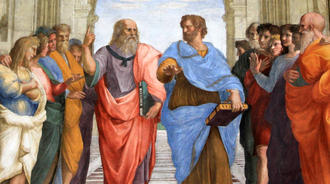
Lyceum
The Lyceum was a temple in Athens dedicated to Apollo Lyceus.

National Archaeological Museum of Athens
The National Archaeological Museum in Athens houses some of the most important artifacts from a variety of archaeological locations around Greece from prehistory to late antiquity. It is considered one of the greatest museums in the world and contains the richest collection of Greek Antiquity artifacts worldwide. It is situated in the Exarcheia area in central Athens between Epirus Street, Bouboulinas Street and Tositsas Street while its entrance is on the Patission Street, adjacent to the historical building of the National Technical University of Athens.
Places from Wikidata and Wikipedia.
Contains affiliate links.