Discover the best time of year, based on historical climate, temperature, and precipitation.
The best time to visit Paris is July, August, September, when the weather, flight prices, and crowds align. — variable climate
🌥Mild
Contains affiliate links.
| Score | 10 | 18 | 34 | 57 | 77 | 80 | 86 | 84 | 85 | 63 | 28 | 12 |
|---|---|---|---|---|---|---|---|---|---|---|---|---|
| Climate | Cold | Cold | Cold | Cold | Mild | Pleasant | Pleasant | Pleasant | Mild | Mild | Cold | Cold |
| Temperature | 2–7°C | 3–9°C | 4–12°C | 6–16°C | 10–19°C | 14–23°C | 15–25°C | 15–25°C | 13–22°C | 10–17°C | 6–11°C | 4–9°C |
| Feels like | -2–4°C | -1–6°C | 0–9°C | 3–13°C | 8–18°C | 13–23°C | 15–25°C | 15–25°C | 11–20°C | 7–15°C | 3–8°C | 0–6°C |
| Precipitation | 64mm 12 days | 53mm 11 days | 70mm 12 days | 51mm 10 days | 79mm 12 days | 72mm 11 days | 46mm 10 days | 68mm 10 days | 60mm 8 days | 71mm 11 days | 66mm 12 days | 75mm 13 days |
| Sunshine | 2.8h ☀︎ 32% | 4.8h ☀︎ 47% | 6.6h ☀︎ 55% | 10.1h ☀︎ 74% | 10.6h ☀︎ 69% | 11.7h ☀︎ 73% | 11.8h ☀︎ 75% | 10.9h ☀︎ 76% | 9.1h ☀︎ 72% | 6.0h ☀︎ 56% | 4.0h ☀︎ 44% | 2.8h ☀︎ 34% |
| Wind | SW · 21 km/h | SW · 22 km/h | SW · 21 km/h | N · 19 km/h | NW · 18 km/h | NW · 17 km/h | NW · 18 km/h | W · 17 km/h | W · 17 km/h | SW · 19 km/h | SW · 20 km/h | SW · 20 km/h |
| Humidity (%) | 86% | 80% | 77% | 71% | 72% | 69% | 64% | 66% | 72% | 81% | 86% | 88% |
| Perfect days | 0% | 0% | 1% | 14% | 26% | 38% | 50% | 48% | 42% | 13% | 0% | 0% |
| Dry streak | 9d | 9d | 11d | 11d | 10d | 9d | 9d | 9d | 12d | 8d | 9d | 8d |
| Sunny streak | 4d | 5d | 9d | 13d | 15d | 16d | 18d | 16d | 11d | 7d | 4d | 4d |
| Extreme heat | — | — | — | — | — | 0% | 2% | 2% | — | — | — | — |
| Extreme cold | 37% | 34% | 18% | 4% | — | — | — | — | — | 0% | 8% | 28% |
| Temperature | +0.2° | +2.3° | +1.8° | -0.3° | -0.1° | +1.1° | +0.6° | +2.4° | +1.3° | +0.5° | +0.6° | +1.8° |
| Rainfall | Stable | Stable | Stable | Stable | Stable | Stable | Stable | Stable | Getting wetter | Getting wetter | Stable | Getting wetter |
| Ideal warm days | 0% | 0% | 0% | 0% | 3% | 13% | 24% | 20% | 10% | 1% | 0% | 0% |
| Outdoor comfort | 0% | 0% | 2% | 16% | 27% | 39% | 44% | 45% | 43% | 15% | 1% | 0% |
| Dry week odds | 13% | 14% | 22% | 25% | 18% | 14% | 16% | 13% | 26% | 11% | 13% | 13% |
| Heavy rain | — | — | — | — | 1% | 2% | 1% | 2% | 1% | — | 1% | 1% |
| Snow days | 9% | 11% | 4% | 2% | — | — | — | — | — | — | 3% | 8% |
| Day length | 8.8h | 10.2h | 11.9h | 13.7h | 15.3h | 16.1h | 15.7h | 14.3h | 12.6h | 10.8h | 9.2h | 8.3h |
| Tourist Crowds | Low season | Low season | High season | High season | High season | High season | High season | High season | High season | High season | Shoulder season | High season |
Iconic military parade on the Champs-Élysées and fireworks at the Eiffel Tower. Expect warm, pleasant weather but massiv…
A globally renowned event showcasing the latest haute couture and ready-to-wear collections. While primarily industry-fo…
Another globally renowned event showcasing the latest haute couture and ready-to-wear collections. The city buzzes with…
A free, city-wide music festival where amateur and professional musicians perform in public spaces. Enjoy the long, warm…
One of the four Grand Slam tennis tournaments, held on clay courts. The weather is typically warm and sunny, making it p…
Paris celebrates the New Year with spectacular fireworks at the Arc de Triomphe and festive gatherings. Be prepared for…
Paris transforms into a festive wonderland with charming Christmas markets and dazzling light displays across the city.…
One of the world's largest marathons, attracting tens of thousands of runners and spectators. The spring weather is usua…
The grand finale of the world's most famous cycling race culminates on the Champs-Élysées. Enjoy the spectacle in warm s…
An all-night contemporary art festival where museums, galleries, and public spaces open for free. The autumn weather is…
The banks of the Seine are transformed into temporary urban beaches with sand, deckchairs, and activities. It's a great…
While conventional lore paints spring as the quintessential Parisian fantasy, the city actually endures its heaviest crush under fickle, chilly skies; it is high summer—especially July—that delivers Paris at its most radiant, relaxed, and genuinely atmospheric.
The lure of Paris is rooted in the grand architectural vision of the nineteenth century: broad limestone boulevards cutting toward monumental vistas, iron balconies overlooking manicured squares, and the timeless rhythm of the Métro with its sweeping Art Nouveau entrances. It is a metropolis built for the pedestrian, an open-air theatre where the simple act of walking along stone embankments or settling into a wicker chair on a sidewalk terrace constitutes the entire agenda. Yet how that theatre feels depends entirely on the sky above it. Come at the wrong turn of the calendar, and the romantic promenade curdles into a grim shuffle beneath leaden cloudbanks and umbrellas.
July is the finest month to experience Paris, and there is no reason to be contrarian about it. The skies settle into a luminous, sustained clarity that bathes the zinc rooftops in warm amber light well into the evening hours. Afternoon temperatures rise to a pleasant warmth without becoming punishing, making long, meandering strolls through Le Marais or up the winding inclines of Montmartre an absolute joy.
What surprises most first-time visitors is the rhythm of the city. While peak season elsewhere in Europe brings claustrophobia, Parisian streets often feel remarkably unburdened in midsummer. A vast portion of the local workforce departs for the coast, taking the edge off commuter traffic and leaving the boulevards of the 6e Arrondissement and the leafy side streets of Batignolles wonderfully breathable. The riverfront becomes an extended living room, where the temporary sands and deckchairs of Paris Plages invite languid afternoons beside the water.
There is spectacle here, too, but it feels earned. Bastille Day galvanizes the whole capital with morning military displays and midnight fireworks, followed later in the month by the thunderous arrival of the Tour de France. Even as August brings intermittent humidity and afternoon cloud bursts, Paris remains bathed in generous daylight, inviting late-night conversations across the breezy plazas of the 11e Arrondissement.
September carries the warmth of late summer directly into the golden hue of early autumn. The air turns clean and crisp, shedding summer haze while holding onto deeply comfortable daytime warmth. It is an electric time across the design corridors of Sentier and the high-fashion precincts of the 1er Arrondissement, when Paris Fashion Week sweeps through town and energizes the terraces with an unmistakable creative charge.
By October, the plane trees drop russet leaves across the wide sidewalks of Montparnasse and the Latin Quarter. The light softens into a silvery tone, and while the days shorten, the weather remains cooperative for walking between museums and covered arcades. When Nuit Blanche takes over the streets in October, throwing open galleries and public installations through the dark hours, the crisp evening chill is easily offset by the warmth of a bustling neighborhood bar in the 10e Arrondissement.
If there is a trap in the Parisian calendar, it lies in the late autumn and deep winter months. November arrives with a damp, low-hanging mist that clings to the limestone facades, and the temperature registers a biting chill that cuts through wool coats. Yet far from offering an empty city for contemplative museum visits, November and January draw astonishingly heavy waves of visitors, crowding Métro platforms and queuing around city blocks in the persistent grey.
December offers a brief theatrical respite when the Paris Christmas Markets & Illuminations transform commercial avenues into glowing corridors of spice and light. The festive air culminate in the massive throngs gathering on New Year's Eve, but the physical reality of the trip remains cold and damp, with only a scant few hours of weak sun filtering through the overcast ceiling each day. The damp chill continues unabated into February, making life on the street feel like an endurance test unless you retreat entirely indoors.
Travel brochures promise an effortless Parisian springtime, but the calendar tells a starkly different story. March and April see the city swell to its absolute peak crowds of the entire year, despite temperatures that hover in a brisk, shuddering single-digit chill and skies that frequently douse the pavements in lingering drizzle. In early spring, visitors pack the pavement of the 7e Arrondissement and the narrow lanes of the Latin Quarter elbow-to-elbow, caught between high expectations and cold, overcast afternoons. Events like the early-season Paris Fashion Week and the sweeping course of the Paris Marathon draw tens of thousands into a city that has not yet warmed up.
Relief finally arrives toward the end of May and blooms fully across June. The clay courts at Roland Garros for the French Open signal the true return of sunlit outdoor leisure. Daylight stretches toward midnight, reaching a jubilant crescendo during the Fête de la Musique in late June, when brass bands, synthesizers, and acoustic guitars commandeer every corner of Ménilmontant and the Faubourg Saint-Antoine, setting the stage for the glorious midsummer days to follow.
Top sights and attractions to build your days around once you know when to go.
The Eiffel Tower is a lattice tower on the Champ de Mars in Paris, France. It is named after the engineer Gustave Eiffel, whose company designed and built the tower from 1887 to 1889.
The Louvre is a national art museum in Paris, France. It is located on the Right Bank of the Seine in the city's 1st arrondissement (district) and home to some of the most canonical works of Western art, including the Mona Lisa, Venus de Milo, and Winged Victory. The museum is housed in the Louvre Palace, originally built in the late 12th to 13th century under Philip II. Remnants of the Medieval Louvre fortress are visible in the basement of the museum. Due to urban expansion, the fortress eventually lost its defensive function, and in 1546 Francis I converted it into the primary residence of the French kings.
Notre-Dame de Paris, often referred to simply as Notre-Dame, is a medieval Catholic cathedral and basilica on the Île de la Cité, in the 4th arrondissement of Paris, France. It is the cathedral church of the Roman Catholic Archdiocese of Paris.
The Musée d'Orsay is a museum in Paris, France, on the Left Bank of the Seine. It is housed in the former Gare d'Orsay, a Beaux-Arts railway station built from 1898 to 1900. The museum holds mainly French art dating from 1848 to 1914, including paintings, sculptures, furniture, and photography. It houses the largest collection of Impressionist and post-Impressionist masterpieces in the world, by painters including Berthe Morisot, Claude Monet, Édouard Manet, Degas, Renoir, Cézanne, Seurat, Sisley, Gauguin, and van Gogh. Many of these works were held at the Galerie nationale du Jeu de Paume prior to the museum's opening in 1986. It is one of the largest art museums in Europe.
The Bastille was a medieval fortress in Paris, known as the Bastille Saint-Antoine. It played an important role in the internal conflicts of France and for most of its history was used as a state prison by the kings of France. It was stormed by a crowd on 14 July 1789, in the French Revolution, becoming an important symbol for the French Republican movement. It was later demolished and replaced by the Place de la Bastille public square in Paris.
The Arc de Triomphe de l'Étoile, often simply called the Arc de Triomphe, is one of the most famous monuments in Paris, France. It is located at the western end of the Champs-Élysées, at the centre of the Place Charles de Gaulle—formerly known as the "Place de l'Étoile"—named for the star-shaped configuration formed by the convergence of twelve radiating avenues. The monument is situated at the intersection of three arrondissements: the 16th, the 17th, and the 8th. Commissioned to honor those who fought and died for France during the French Revolutionary and Napoleonic Wars, the Arc bears the names of French victories and its generals engraved on its inner and outer surfaces. Beneath its vault lies the Tomb of the Unknown Soldier from World War I, marked by an eternal flame commemorating unidentified fallen soldiers of the French Nation.
Stade de France is the national stadium of France, located just north of Paris in the commune of Saint-Denis. Its seating capacity of 81,338 makes it the largest stadium in France. The stadium is used by the French national football team and rugby union teams for international competitions. It is the largest in Europe for athletics events, seating 77,083 in that configuration. During other events, the stadium's running track is mostly hidden under the grandstands.
The Élysée Palace is the official residence of the president of France in Paris. Completed in 1722, it was built for Louis Henri de La Tour d'Auvergne, a nobleman and army officer who had been appointed governor of Île-de-France in 1719. It is located on the Rue du Faubourg Saint-Honoré in the 8th arrondissement, near the Champs-Élysées. The name Élysée derives from the Elysian Fields, the place of the blessed dead in Greek mythology.
The Centre Pompidou, more fully the Centre national d'art et de culture Georges-Pompidou, also known as the Pompidou Centre in English and colloquially as Beaubourg, is a building complex in Paris, France. It was designed in the style of high-tech architecture by the architectural team of Richard Rogers, Su Rogers and Renzo Piano, along with Gianfranco Franchini. It is named after Georges Pompidou, the President of France from 1969 to 1974 who commissioned the building, and was officially opened on 31 January 1977 by President Valéry Giscard d'Estaing.
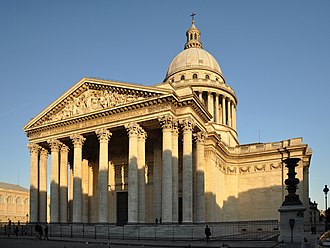
The Panthéon is a monument in the 5th arrondissement of Paris, France. It stands in the Latin Quarter, on the Montagne Sainte-Geneviève, in the centre of the Place du Panthéon, which was named after it. The edifice was built between 1758 and 1790, from designs by Jacques-Germain Soufflot, at the behest of King Louis XV; the king intended it as a church dedicated to Saint Genevieve, Paris's patron saint, whose relics were to be housed in the church. Neither Soufflot nor Louis XV lived to see the church completed.
The Basilica of Saint-Denis is a Roman Catholic cathedral that originated as a medieval abbey church. It is located in the commune of Saint-Denis, a northern suburb of Paris, France. The building is of singular importance historically and architecturally because its choir, completed in 1144, is widely considered the first structure to employ all of the elements of Gothic architecture.
The Basilica of the Sacred Heart of Montmartre, commonly known as Sacré-Cœur Basilica or simply Sacré-Cœur, is a Catholic church and minor basilica in Paris dedicated to the Sacred Heart of Jesus.
Places from Wikidata and Wikipedia.
Contains affiliate links.