Discover the best time of year, based on historical climate, temperature, and precipitation.
The best weather in Palermo is from April, May, June, but considering flight prices and crowds, the best months to visit are April, May, November. — predictable climate
🌦Humid
Contains affiliate links.
| Score | 52 | 58 | 67 | 88 | 86 | 95 | 75 | 70 | 85 | 79 | 77 | 64 |
|---|---|---|---|---|---|---|---|---|---|---|---|---|
| Climate | Cold | Mild | Mild | Mild | Pleasant | Pleasant | Hot & dry | Hot & dry | Pleasant | Humid | Cool & rainy | Mild |
| Temperature | 9–14°C | 9–15°C | 10–16°C | 12–19°C | 15–22°C | 20–27°C | 23–30°C | 23–30°C | 21–27°C | 17–24°C | 14–20°C | 11–16°C |
| Feels like | 6–12°C | 7–13°C | 8–15°C | 11–19°C | 15–24°C | 21–30°C | 25–35°C | 26–34°C | 23–30°C | 18–25°C | 13–19°C | 9–15°C |
| Precipitation | 83mm 11 days | 83mm 11 days | 94mm 12 days | 38mm 9 days | 60mm 7 days | 20mm 4 days | 9mm 2 days | 28mm 4 days | 66mm 10 days | 96mm 11 days | 112mm 12 days | 84mm 11 days |
| Sunshine | 8.0h ☀︎ 81% | 8.8h ☀︎ 82% | 9.9h ☀︎ 82% | 10.7h ☀︎ 81% | 12.2h ☀︎ 85% | 13.3h ☀︎ 90% | 13.8h ☀︎ 95% | 12.6h ☀︎ 93% | 11.0h ☀︎ 89% | 9.4h ☀︎ 84% | 8.1h ☀︎ 80% | 7.7h ☀︎ 81% |
| Wind | W · 18 km/h | SW · 17 km/h | SW · 17 km/h | S · 15 km/h | NE · 14 km/h | NE · 13 km/h | NE · 13 km/h | NE · 13 km/h | NE · 14 km/h | S · 14 km/h | SW · 15 km/h | SW · 17 km/h |
| Humidity (%) | 77% | 76% | 75% | 72% | 73% | 69% | 64% | 67% | 74% | 77% | 79% | 78% |
| Perfect days | 1% | 3% | 8% | 29% | 64% | 54% | 13% | 10% | 43% | 57% | 30% | 3% |
| Dry streak | 10d | 9d | 9d | 11d | 14d | 19d | 21d | 22d | 9d | 10d | 8d | 9d |
| Sunny streak | 16d | 15d | 19d | 20d | 27d | 29d | 31d | 31d | 24d | 19d | 17d | 14d |
| Extreme heat | — | — | — | — | 0% | 2% | 4% | 4% | 1% | — | — | — |
| Extreme cold | — | — | — | — | — | — | — | — | — | — | — | 0% |
| Temperature | +1.0° | +2.3° | +0.2° | -0.3° | -0.8° | 0.0° | +0.7° | +0.8° | +1.7° | +1.7° | +1.5° | +1.4° |
| Rainfall | Stable | Stable | Stable | Getting drier | Getting wetter | Stable | Stable | Stable | Stable | Stable | Getting wetter | Stable |
| Ideal warm days | 0% | 0% | 0% | 1% | 10% | 50% | 72% | 65% | 41% | 12% | 0% | 0% |
| Outdoor comfort | 2% | 5% | 20% | 50% | 61% | 23% | 3% | 2% | 21% | 51% | 42% | 7% |
| Dry week odds | 17% | 18% | 15% | 23% | 35% | 57% | 72% | 64% | 17% | 16% | 10% | 14% |
| Heavy rain | 1% | 3% | 2% | 1% | 1% | 1% | — | 1% | 2% | 4% | 2% | 2% |
| Snow days | 3% | 4% | 2% | — | — | — | — | — | — | — | — | 1% |
| Muggy days | — | — | — | — | — | 7% | 29% | 46% | 26% | 1% | — | — |
| Oppressive days | — | — | — | — | — | — | — | 1% | — | — | — | — |
| Day length | 9.9h | 10.8h | 12.0h | 13.2h | 14.2h | 14.8h | 14.5h | 13.6h | 12.4h | 11.2h | 10.1h | 9.6h |
| Tourist Crowds | Low season | Low season | Low season | Shoulder season | Shoulder season | High season | High season | High season | High season | Shoulder season | Low season | Low season |
Palermo's most important religious festival, celebrating its patron saint with a grand procession and fireworks. Expect…
Experience world-class opera, ballet, and concerts at the magnificent Teatro Massimo, one of Europe's largest opera hous…
A vibrant celebration of LGBTQ+ rights and culture, Palermo Pride features a colorful parade, concerts, and public event…
Palermo observes Holy Week with solemn processions and ancient rituals, particularly vibrant in the city's historic neig…
An international artisan ice cream festival, bringing master gelato makers from around the world to Palermo. Held in lat…
Palermo celebrates New Year's Eve with public concerts, fireworks displays over the harbor, and lively street parties. D…
Throughout December, Palermo's squares transform with festive Christmas markets, offering local crafts, traditional swee…
A celebration of Palermo's renowned street food culture, this festival brings together vendors offering arancine, panell…
Celebrated on March 19th, Saint Joseph's Day is a significant religious and cultural event in Palermo, marked by special…
A historic car rally that revives the legendary Targa Florio race, showcasing vintage and classic automobiles through th…
Standard guidebooks tell you that Palermo belongs to June, but they are mistaking postcard stillness for the soul of the city: November is when Palermo belongs entirely to itself, trading blinding sun for theatrical street life, opera, and an unapologetic urban grit that summer bleaches away.
Every generic travel guide tells you to arrive in Palermo when the skies are spotless and the Tyrrhenian Sea is warm enough for swimming. They point you toward June, when the sun blazes over the stone facades and the city behaves like a resort. But Palermo is not a resort. It is a 2,700-year-old layered metropolis founded by Phoenicians, shaped by Arab emirs, Norman kings, and Spanish viceroys, where street vendors still shout in cadences inherited from North African souks. When you visit only for the beach weather, you get an overheated shell. If you want to understand the living, breathing drama of the place, you have to look at the months the guides tell you to avoid—starting with the intense, moody magic of late autumn.
Conventional logic calls November the low season, pointing at the gathering rainclouds and shorter afternoons. That calculation misses the point of Sicily's capital. November is the month when the city operates at its absolute fullest human density, completely reclaimed by the people who live here. The suffocating summer haze has lifted, replaced by a crisp sea air that invites you to walk across the whole historic center without seeking refuge every hundred meters.
Yes, the clouds roll in off the gulf and drop sudden, theatrical downpours, but the stone flags of Quattro Canti dry quickly under the maritime breeze. Between the showers, the markets of Ballarò and Capo are intoxicating hives of activity, steaming with fresh chickpea fritters and roast chestnuts under amber streetlights. The opera season opens its velvet doors at Teatro Massimo, drawing an impeccably dressed crowd into one of the grandest auditoriums in Europe.
Where a June visit forces you out of town toward the sand, November pulls you inward, into medieval alleyways, baroque oratories, and cavernous vaulted taverns where plates of pasta con le sarde taste right because the air demands substance. It is busy, messy, vibrant, and utterly genuine.
Winter in Palermo does not freeze; it broods. Temperatures hover in the mid-teens, and while gray skies and steady showers are part of the rhythm, the cold rarely bites to the bone. Instead, winter brings a cinematic gravitas to the decaying palazzi of Kalsa and the weathered stone of Cattedrale di Palermo.
December wraps the center in celebration. Festive wooden stalls take over the squares for the Palermo Christmas Markets, filling the air with the aroma of fried dough and spiced citrus, culminating in New Year's Eve concerts and fireworks that illuminate the harbor. Teatro Massimo anchors the cultural calendar through January and February, staging world-class opera and ballet to packed houses while the rest of the island sleeps.
This is the time to explore the vast interiors: the golden Byzantine mosaics inside Palazzo dei Normanni feel infinitely richer when you are not sharing the hall with tour buses. You will need a proper coat for damp evenings, but in exchange, you gain an intimacy with the city that summer visitors never glimpse.
Spring arrives not as a gentle bloom, but as a series of intense cultural rituals. March brings Saint Joseph's Day, when families construct ornate altars and bakeries across the city pile their counters high with sweet, ricotta-crowned sfince. By April, Holy Week takes over the historic core with haunting night processions, as cloaked brotherhoods carry heavy wooden floats through winding lanes to the measured rhythm of muffled funeral marches.
As the sun gains strength through April and May, the city’s culinary life spills permanently onto the pavement. The Palermo Street Food Festival arrives, celebrating the city's obsession with sfincione, panelle, and spleen sandwiches. The weather during these weeks is mild and dry, making long wanders through the historic center effortlessly comfortable.
It is an easy season to love, though crowds swell around Easter and the major religious holidays. If you want Palermo at its gentlest, May delivers long golden afternoons without the aggressive heat that lurks just around the corner.
June is technically the calendar's weather masterpiece: nearly thirteen hours of sunshine a day, dry air, and the city draped in vibrant color. Palermo Pride turns the central avenues into a joyous open-air party under pristine blue skies. For anyone whose holiday depends strictly on radiant sunshine, June delivers perfection.
By July and August, however, the climate turns punishing. Apparent temperatures regularly surge past thirty-four degrees, turning the stone alleys into ovens and forcing daily life into a midday coma. The only sensible escape is hopping the bus to the white sand of Mondello or retreating to the shade of Monte Pellegrino, where pine trees offer faint relief from the glare.
The undeniable climax of midsummer is the Feast of Saint Rosalia in mid-July. The entire population pours into the streets for the patron saint's procession, following a colossal float through the ancient center down to the sea, ending in a thunderous midnight firework barrage over the water. It is magnificent, chaotic, and stiflingly hot. If you come in late summer, prepare to live entirely between sundown and midnight.
September breaks the back of the summer heat. The sea remains warm enough for swimming along the coastline, but the frantic resort crowds thin out, leaving room to breathe. Food lovers reassert control over the streets, drawn by another round of the Palermo Street Food Festival and the Sherbeth Festival, which gathers artisan gelato masters from around the globe to churn imaginative flavors in the open squares.
By October, autumn takes a firmer hold. Rallies like the Targa Florio Classica send gleaming vintage automobiles roaring through the city outskirts into the mountain roads, accompanied by mild, comfortable afternoons. Rains pick up noticeably toward late October, washing away the stubborn summer dust and signaling the approach of winter.
These weeks offer a graceful equilibrium: the sun still warms your shoulders at noon, the outdoor tables at the edge of Vucciria remain packed into the small hours, and the frantic coastal rush has finally subsided into something dignified and relaxed.
Top sights and attractions to build your days around once you know when to go.
Stadio Renzo Barbera is a football stadium in Palermo, Italy. It is currently the home stadium of Palermo FC. The stadium was inaugurated during the fascist era on 24 January 1932, and was originally named Stadio Littorio after the Italian word for the fasces symbol. The opening match was Palermo vs Atalanta, with Palermo winning 5–1. A running track surrounded the pitch, and there were no stands behind either goal. In 1936, the stadium was renamed Stadio Michele Marrone, in memory of a soldier killed during the Spanish Civil War. In 1945, the name was changed again at the end of World War II to Stadio La Favorita, taken from the name of the local ancient game preserve of Frederick II, Holy Roman Emperor in the 13th century.
Palermo Cathedral is the cathedral church of the Roman Catholic Archdiocese of Palermo, located in Palermo, Sicily, southern Italy. It is dedicated to the Assumption of the Virgin Mary. As an architectural complex, it is characterized by the presence of different styles, due to a long history of additions, alterations and restorations, the last of which occurred in the 18th century.
Monreale Cathedral is a Catholic church in Monreale, a municipality in the Metropolitan City of Palermo, Sicily. One of the greatest extant examples of Norman architecture, it was begun in 1174 by William II of Sicily and is dedicated to the Nativity of the Virgin Mary. The church was elevated by a bull of Pope Lucius III to the rank of a metropolitan cathedral in 1182 as the seat of the diocese of Monreale, which was elevated to the Archdiocese of Monreale in 1183. Since 2015 it has been part of the Arab-Norman Palermo and the Cathedral Churches of Cefalù and Monreale UNESCO World Heritage Site.
The Palatine Chapel /ˈpælətaɪn ˈtʃæpəl/ is the royal chapel of the Norman Palace in Palermo, Sicily. This building is a mixture of Byzantine, Norman, and Fatimid architectural styles, showing the tricultural state of Sicily during the 12th century after Roger I and Robert Guiscard conquered the island.
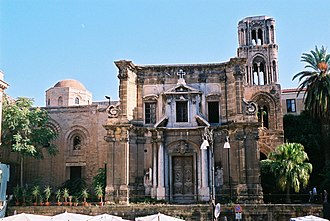
The Church of St. Mary of the Admiral, also called Martorana, is the seat of the Parish of San Nicolò dei Greci, overlooking the Piazza Bellini, next to the Norman church of San Cataldo and facing the Baroque church of Santa Caterina, in Palermo, Italy.
The Palazzo dei Normanni, also called Royal Palace of Palermo, is a palace in Palermo, Sicily, Italy. It was the seat of the Kings of Sicily with the Hauteville dynasty and served afterwards as the main seat of power for the subsequent rulers of Sicily. Since 1946 it has been the seat of the Sicilian Regional Assembly. The building is the oldest royal residence in Europe; and was the private residence of the rulers of the Kingdom of Sicily and the imperial seat of Frederick II and Conrad IV.
The Church of San Cataldo is a Catholic church located at Piazza Bellini, in central Palermo, Sicily, Italy. Erected in 1154 as a notable example of the Arab-Norman architecture which flourished in Sicily under Norman rule on the island, the church is annexed to that of Santa Maria dell'Ammiraglio. Since the 1930s, it belongs to the Order of the Holy Sepulchre.
The Capuchin Catacombs of Palermo are burial catacombs in Palermo, Sicily, southern Italy. Today they provide a somewhat macabre tourist attraction as well as an extraordinary historical record.
San Giovanni degli Eremiti is an ancient former monastic church located on Via Benedettini #19 in the ancient quarter of Albergaria of the city of Palermo, region of Sicily, Italy. It is about two blocks south from the Palazzo dei Normanni, adjacent to the church of San Giorgio in Kemonia. While the interior is virtually devoid of decoration or furnishings, the Islamic domes, Romanesque cloister ruins, and garden make this small church a symbol of ancient Palermo.
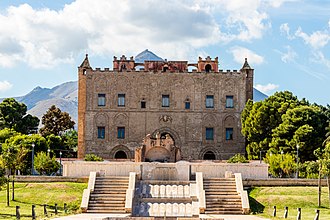
The Zisa is a grand 12th-century Norman hunting lodge and summer palace in the western area of Palermo, in the region of Sicily, Italy. The edifice was started around 1165 by Arab craftsmen under the rule of the Norman conqueror of Sicily, king William I. It was not finished until 1189, under the rule of William II. It is presently open to the public for tours.
Palazzo Natoli is a Baroque palace in Palermo, in the Mediterranean island of Sicily. It was built by Vincenzo Natoli in 1765. It has a fine entrance on via S. Salvatore, and frescoes by Gioacchino Martorana.
The Church of the Gesù, known also as the Saint Mary of Jesus or the Casa Professa, is a Baroque-style, Roman Catholic church established under the patronage of the Jesuit order, and located at Piazza Casa Professa 21 in Palermo, region of Sicily, Italy.
Places from Wikidata and Wikipedia.
Contains affiliate links.