Things to do in Mosul
Top sights and attractions to build your days around once you know when to go.

Nineveh
Nineveh was an ancient Near Eastern city of Upper Mesopotamia, located in the modern-day city of Mosul in northern Iraq. It is located on the eastern bank of the Tigris River and was the capital and largest city of the Neo-Assyrian Empire, and potentially the wealthiest city in the ancient world. Today, it is a common name for the half of Mosul that lies on the eastern bank of the Tigris, and the country's Nineveh Governorate takes its name from it.

Great Mosque of al-Nuri
The Great Mosque of al-Nuri, also known as the Nouri Mosque, is a Sunni mosque in Mosul, in the Nineveh Governorate of Iraq, famous for its leaning minaret, which gave the city its nickname "the hunchback". Tradition holds that the mosque was built in the late 12th century, although it underwent many renovations over the years. The mosque withstood various hostile invading forces over its 850-year history until it was destroyed, along with its distinctive minaret, in the 2017 Battle of Mosul.

Dair Mar Elia
The Monastery of Saint Elijah, or Dair Mar Elia, was located in Mosul, Nineveh Governorate, Iraq. Established in the late 6th century, it was one of Iraq's oldest monasteries. It belonged to the Church of the East and then to the Chaldean Catholic Church. The monastery was shut down in 1743, when the Afsharids massacred its monks after they refused to convert to Islam, and went on to become a Christian pilgrimage site. Its ruins were damaged during the 2003 invasion of Iraq, and were destroyed entirely by the Islamic State in 2014.

Mosul Museum
The Mosul Museum is the second largest museum in Iraq after the National Museum of Iraq in Baghdad. It was heavily looted during the 2003 Iraq War. Founded in 1952, the museum consisted of a small hall until a new building was opened in 1972, containing ancient Assyrian artifacts. The museums net worth and content value are around 50 to 80 to 250 million according to museum specialists during 2013 at least. Hikmat Al-Aswad was the director from 2004 to 2011. The current director is Zaid Ghazi Saadallah.

Bash Tapia Castle
Bash Tapia Castle, also known as Bashtabiya Castle or Pashtabia Castle, is a ruined 12th-century castle located on the western bank of the Tigris river, forming part of the city wall of Mosul, Iraq. It was partially destroyed by the Islamic State of Iraq and the Levant (ISIL) in April 2015.

Mosque of the Prophet Yunus
Al-Nabi Yunus Mosque, also known as the Mosque of the Prophet Jonah, and the Shrine of Nabi Yunis, was a historic Sunni congregational mosque and shrine, partially destroyed in 2014, that was located in Mosul, in the Nineveh Governorate of Iraq. It contained a tomb believed to be that of the Abrahamic prophet Jonah, known as Yunus by Muslims. After the liberation of Mosul, additional excavations revealed the ruins of a Neo-Assyrian palace beneath the mosque.
Tarbisu
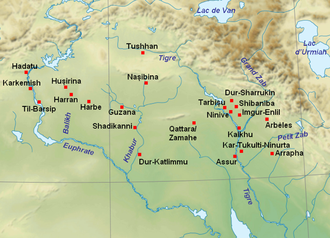
Tarbiṣu was an ancient city about 3 miles north of Nineveh.

Saint George Mosque
The Al-Nabi Jirjis Mosque is a mosque located in Mosul, Iraq. It is named after Saint George, known in Islamic tradition as Jirjis, who is believed by locals to be buried in the mausoleum attached to the mosque. While the date of construction of the mausoleum is unknown, the mosque was built by Tamerlane in the 14th century.

Mosul Grand Mosque
The Mosul Grand Mosque is an incomplete Sunni mosque located in Mosul, in the Nineveh Governorate of Iraq. It is situated in the Taqafah district, bordering the Tigris river near the Nineveh archeological site. When completed, it will be the largest mosque in Mosul.

Our Lady of the Hour Church
The Our Lady of the Hour Church also known as the name of the Latin Church, is a Catholic church in the centre of Mosul, in northern Iraq. Built in the 1870s by the Dominican Fathers, it was especially famous for its bell donated by the Empress Eugenia de Montijo, for which it was sometimes called the Clock Church. It was damaged in a 2006 bombing and completely restored in 2023.

Pasha Mosque, Mosul
The Al-Basha Mosque, formerly known as al-Khabazin Mosque, is a mosque located in the Bab al-Saray area of Mosul, Iraq.
Places from Wikidata and Wikipedia.
Contains affiliate links.