Things to do in Moscow
Top sights and attractions to build your days around once you know when to go.

Kremlin
The Moscow Kremlin, commonly known as the Kremlin, is a fortified complex (kremlin) in Moscow, Russia. Located in the historic centre of the country's capital city, the Kremlin comprises five palaces, four cathedrals, and an enclosing wall along with numerous towers. Within the complex is the Grand Kremlin Palace, which was one of the royal residences of the Tsar of Russia, and is now the residence of the president of the Russian Federation. The Kremlin overlooks the Moskva River to the south, Red Square to the east, and Alexander Garden to the west.

St. Basil's Cathedral
The Cathedral of Vasily the Blessed, commonly known as Saint Basil's Cathedral, is a Russian Orthodox church on Red Square in the historic centre of Moscow. It is one of the most popular cultural symbols of Russia. The building, now a museum, is officially known as the Cathedral of the Intercession of the Most Holy Theotokos on the Moat, or Pokrovsky Cathedral. It was built from 1555 to 1561 on orders from Ivan the Terrible and commemorates the capture of Kazan and Astrakhan. It was completed, with its colours, in 1683.

Luzhniki Stadium
The Grand Sports Arena of the Luzhniki Olympic Complex, commonly known as Luzhniki Stadium and formerly, Lenin Stadium, is the national stadium of Russia, located in its capital city, Moscow. Its total seating capacity of 81,000 makes it the largest football stadium in Russia and the sixth-largest stadium in Europe. The stadium is a part of the Luzhniki Olympic Complex, and is located in Khamovniki District of the Central Administrative Okrug of Moscow city. The name Luzhniki derives from the flood meadows in the bend of Moskva River where the stadium was built, translating roughly as "The Meadows". The stadium is located at Luzhniki Street, 24, Moscow.

Lenin's Mausoleum
Lenin's Mausoleum, also known as Lenin's Tomb, is a mausoleum located at Red Square in Moscow, Russia. It serves as the resting place of Soviet leader Vladimir Lenin, whose preserved body has been on public display since shortly after his death in 1924, with rare exceptions in wartime. From 1953 to 1961, it was named Lenin's and Stalin's Mausoleum. The outdoor tribune over the mausoleum's entrance was used by Soviet leaders to observe military parades. The structure, designed by Alexey Shchusev, incorporates some elements from ancient mausoleums such as the Step Pyramid, the Tomb of Cyrus the Great and, to some degree, the Temple of the Inscriptions.

Cathedral of Christ the Saviour
The Cathedral of Christ the Saviour is a Russian Orthodox cathedral in Moscow, Russia, on the northern bank of the Moskva River, a few hundred metres southwest of the Kremlin. With an overall height of 103 metres (338 ft), it is the third tallest Orthodox Christian church building in the world.

Tretyakov Gallery
The State Tretyakov Gallery is an art gallery in Moscow, Russia, which is considered the foremost depository of Russian fine art in the world.
Russian State Library
The Russian State Library is one of the three national libraries of Russia, located in Moscow. It is the largest library in the country, second largest in Europe and one of the largest in the world. Its holdings crossed over 47 million units in 2017. It is a federal library overseen by the Ministry of Culture, including being under its fiscal jurisdiction.

Ostankino Tower
The Ostankino Tower is a television and radio tower in Moscow, Russia, owned by the Moscow branch of unitary enterprise Russian TV and Radio Broadcasting Network. Standing 540.1 metres (1,772 ft), it was designed by Nikolai Nikitin. As of 2026, it is the tallest free-standing structure in Europe and 15th tallest in the world. Between 1967 and 1974, it was the tallest in the world. The tower was the first free-standing structure to exceed 500 m (1,600 ft) in height. Ostankino was built to mark the 50th anniversary of the October Revolution. It is named after the surrounding Ostankino district of Moscow.

Moscow Conservatory
The Moscow Conservatory, also officially Tchaikovsky Moscow State Conservatory is a higher musical educational institution located in Moscow, Russia. It grants undergraduate and graduate degrees in musical performance and musical research. The conservatory offers various degrees including Bachelor of Music Performance, Master of Music and PhD in research.
Pushkin Museum of Fine Arts
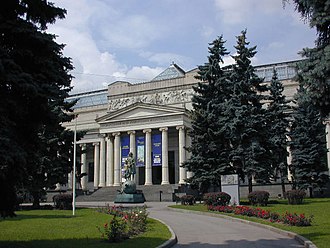
The Pushkin State Museum of Fine Arts is the largest museum of European art in Moscow. It is located in Volkhonka street, just opposite the Cathedral of Christ the Saviour. The International musical festival Sviatoslav Richter's December Nights has been held in the Pushkin Museum since 1981.

Novodevichy Cemetery
Novodevichy Cemetery is a cemetery in Moscow, Russia. It lies next to the southern wall of the 16th-century Novodevichy Convent.

Novodevichy Convent
Novodevichy Convent, also known as Bogoroditse-Smolensky Monastery, is probably the best-known cloister of Moscow. Its name, sometimes translated as the New Maidens' Monastery, was devised to differ from the Old Maidens' Monastery within the Moscow Kremlin. The convent was founded by Grand Duke Vasily III on May 13, 1524 in honor of the Smolensk Icon of the Mother of God "Hodegetria" - the main shrine of Smolensk, in gratitude for the capture of Smolensk in 1514. Unlike other Moscow cloisters, it has remained virtually intact since the 17th century. In 2004, it was proclaimed a UNESCO World Heritage Site.
Places from Wikidata and Wikipedia.
Contains affiliate links.