Things to do in Marseille
Top sights and attractions to build your days around once you know when to go.

Stade Vélodrome
The Stade Vélodrome, known for sponsorship reasons as the CEPAC Vélodrome since July 2026, is a multi-purpose stadium in Marseille, France. It is home to the Olympique de Marseille football club of Ligue 1 since it opened in 1937 and has been a venue in the 1938 and 1998 FIFA World Cups; the 1960, 1984 and 2016 editions of the UEFA European Championship and the 2007 and 2023 Rugby World Cup and football at the 2024 Summer Olympics. It occasionally hosts RC Toulon rugby club of the Top 14. It is the second largest stadium in France, behind Stade de France in Saint-Denis (Paris) with a capacity of 67,394 spectators. The stadium is also used regularly by the France national rugby union team.

Notre-Dame de la Garde
Notre-Dame de la Garde, known to local citizens as la Bonne Mère, is a Catholic basilica in Marseille, France, and the city's best-known symbol. The site of a popular Assumption Day pilgrimage, it is the most visited site in Marseille. It was built on the foundations of an ancient fort at the highest natural point in the city, a 149 m (489 ft) limestone outcropping on the south side of the Old Port of Marseille.

Marseille Cathedral
Marseille Cathedral is a Roman Catholic cathedral and a national monument of France. Located in Marseille, it has been a basilica minor since 1896. It is the seat of the Archdiocese of Marseille.

Calanques National Park
Calanques National Park is a French national park located on the Mediterranean coast in Bouches-du-Rhône, Southern France, slightly west of the French Riviera.

Museum of European and Mediterranean Civilisations
The Museum of European and Mediterranean Civilizations is a national museum located in Marseille, France. It was inaugurated on 7 June 2013 as part of Marseille-Provence 2013, a year when Marseille was designated as the European Capital of Culture. In 2015, it won the Council of Europe Museum Prize.

Cosquer Cave
Cosquer Cave is located in the Calanque de Morgiou in Marseille, France, near Cap Morgiou. The entrance to the cave is located 37 m (121 ft) underwater, due to the Holocene sea level rise, and contains various prehistoric rock art engravings. Its submarine entrance was discovered in 1985 by Henri Cosquer, a professional diver. The underwater passage leading to the cave was progressively explored until 1990 by cave divers, without the divers being aware of the archaeological character of the cave.
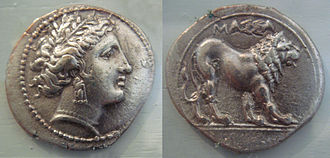
Massalia
Massalia was an ancient Greek colony (apoikia) on the Mediterranean coast, east of the Rhône. Settled by Ionians from Phocaea c. 600 BC, this apoikia grew up rapidly, and became the center of ancient Greek trade in western Mediterranean, branching out and creating many outposts on the coasts of what is now Spain, the south of France, and northwestern Italy. Massalia persisted as an independent colony until the Roman campaign in Gaul in the 1st century BC. The ruins of Massalia still exist in the contemporary city of Marseille, which is considered the oldest city of France and one of Europe's oldest continuously inhabited settlements.

Abbey of St. Victor
The Abbey of Saint-Victor, Marseille is a former abbey that was founded during the late Roman period in Marseille in the south of France, named after the local soldier saint and martyr Victor of Marseilles.

Musée des beaux-arts de Marseille
The Musée des beaux-arts de Marseille is one of the main museums in the city of Marseille, in the Provence-Alpes-Côte d'Azur region. It occupies a wing of the Palais Longchamp, and displays a collection of paintings, sculptures and drawings from the 16th to 19th centuries.

Musée Cantini
The Musée Cantini is a museum in Marseille that has been open to the public since 1936. The museum specializes in modern art, especially paintings from the first half of the 20th century.

Palais du Pharo
The Palais du Pharo is a palace in Marseille, southern France, overlooking the Mediterranean Sea, west of the Old Port (Vieux-Port). It was built in Second Empire style by Emperor Napoleon III for Empress Eugénie, starting in 1858. However, at the fall of the Second Empire in 1870, the building had just been finished. Nowadays, the palace and its gardens are used for events, with the park open to the public. In 2025 it became a monument historique, celebrating its significance in local heritage.

Synagogue of Marseille
The Great Synagogue of Marseille is a Jewish congregation and synagogue located on Rue Breteuil in the 6th arrondissement of Marseille, France. The building was listed as a monument historique in 2007. The congregation worships in the Sephardi rite.
Places from Wikidata and Wikipedia.
Contains affiliate links.