Things to do in Mantova
Top sights and attractions to build your days around once you know when to go.

Basilica of Sant'Andrea
The Basilica of Sant'Andrea is a Roman Catholic co-cathedral and minor basilica in Mantua, Lombardy (Italy). It is one of the major works of 15th-century Renaissance architecture in Northern Italy. Commissioned by Ludovico III Gonzaga, the church was begun in 1472 according to designs by Leon Battista Alberti on a site occupied by a Benedictine monastery, of which the bell tower (1414) remains. The building, however, was only finished 328 years later. Though later changes and expansions altered Alberti's design, the church is still considered to be one of Alberti's most complete works. It looms over the Piazza Mantegna.

Palazzo del Te
Palazzo del Te, or simply Palazzo Te, is a palace in the suburbs of Mantua, Italy. It is an example of the mannerist style of architecture, and the acknowledged masterpiece of Giulio Romano.

Palazzo Ducale Mantua
The Palazzo Ducale in Mantua, also known as the Gonzaga Palace, is one of the city's main historic buildings. From 1308, it served as the official residence of the Lords of Mantua, initially the Bonacolsi, and later the main residence of the Gonzaga, who were lords, marquesses, and eventually dukes of the Virgilian city. It housed the reigning Gonzaga, his wife, their legitimate firstborn son, other legitimate children until adulthood, and notable guests. It was designated the Royal Palace during the Austrian domination starting from the reign of Maria Theresa.

Mantua Cathedral
Mantua Cathedral in Mantua, Lombardy, northern Italy, is a Roman Catholic cathedral dedicated to Saint Peter. It is the seat of the Bishop of Mantua.

Rotonda di San Lorenzo
The Rotonda di San Lorenzo is a religious building in Mantua, Lombardy.

Stadio Danilo Martelli
Stadio Danilo Martelli is the main stadium in Mantua, Italy. It is named Danilo Martelli, a Mantuan footballer from the 1940s, who died in the Superga air disaster of 1949. It is currently used mostly for football matches and, on occasion, for concerts. It is the home of A.C. Mantova.
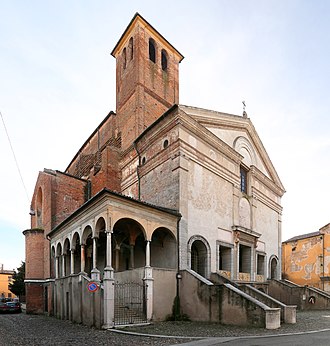
San Sebastiano
San Sebastiano is an Early Renaissance church in Mantua, Northern Italy. Begun in 1460 according to the designs of Leon Battista Alberti, it was left partially completed in the mid-1470s, by which time construction had slowed and was no longer being directed by Alberti. As a consequence, little remains of Alberti’s work apart from the plan, which is considered one of the earliest and most significant examples of the Renaissance's centrally-planned churches. The plan is in the shape of a Greek cross, with three identical arms centering apses, under a central cross-vaulted space without any interior partitions. The church sits on a ground-level crypt which was intended to serve as a mausoleum for the Gonzaga family.

Saint George Castle
The Castello di San Giorgio is part of the Ducal palace of Mantua. It is a moated rectangular castle, each of which's four corners has a large tower and the moat is crossed by three drawbridges.

Teatro Bibiena
The Teatro Bibiena is a theatre in Mantua, Italy. Designed by Antonio Galli da Bibbiena, it was built in 1767–69 and decorated in 1773–75 with a Piermarini façade by Paolo Pozzo (1741–1803).
Places from Wikidata and Wikipedia.
Contains affiliate links.