Things to do in Malta
Top sights and attractions to build your days around once you know when to go.

Hypogeum of Ħal Saflieni
The Hypogeum of Ħal Saflieni is a Neolithic subterranean structure dating to the Saflieni phase in Maltese prehistory, located in Paola, Malta. It is often simply referred to as the Hypogeum, literally meaning "underground" in Greek. The Hypogeum is thought to have been a sanctuary and necropolis, with the estimated remains of more than 7,000 people documented by archeologists, and is among the best preserved examples of the Maltese temple building culture that also produced the Megalithic Temples and Xagħra Stone Circle.

St. John's Co-Cathedral
St John's Co-Cathedral is a Catholic co-cathedral in Valletta, Malta, dedicated to Saint John the Baptist. It was built by the Order of St. John between 1573 and 1578, having been commissioned by Grand Master Jean de la Cassière as the Conventual Church of Saint John.

Ta' Qali National Stadium
The National Stadium, locally also referred to as Ta' Qali, officially known as Grawnd Nazzjonali, is a stadium located in Ta' Qali, Malta. The stadium, which also contains the headquarters of the Malta Football Association, seats 16,997 people and is, by far, the largest stadium in the country. It serves as the national football stadium of Malta and is the home stadium of the Malta national football team. The stadium, together with three other stadiums, also hosts the Maltese Premier League.

Mnajdra
Mnajdra is a megalithic temple complex found on the southern coast of the Mediterranean island of Malta. Mnajdra is approximately 497 metres (544 yd) from the Ħaġar Qim megalithic complex. Mnajdra was built around the fourth millennium BCE; the Megalithic Temples of Malta are among the most ancient religious sites on Earth, described by the World Heritage Sites committee as "unique architectural masterpieces." In 1992, UNESCO recognized the Mnajdra complex and four other Maltese megalithic structures as UNESCO World Heritage Sites. In 2009, work was completed on a protective tent.

Ħaġar Qim
Ħaġar Qim is a megalithic temple complex found on the Mediterranean island of Malta, dating from the Ġgantija phase (3600–3200 BC). The Megalithic Temples of Malta are among the most ancient religious sites on Earth, described by the World Heritage Sites committee as "unique architectural masterpieces." In 1992 UNESCO recognized Ħaġar Qim and four other Maltese megalithic structures as World Heritage Sites. V. Gordon Childe, Professor of Prehistoric European Archeology and director of the Institute of Archaeology in the University of London from 1946 to 1957 visited Ħaġar Qim. He wrote, "I have been visiting the prehistoric ruins all round the Mediterranean, from Mesopotamia to Egypt, Greece and Switzerland, but I have nowhere seen a place as old as this one."

Tarxien Temples
The Ħal Tarxien Prehistoric Complex is an archaeological complex in Tarxien, within the Port region of Malta. They date to approximately 3400 BC. The site was accepted as a UNESCO World Heritage Site in 1992 along with the other Megalithic temples on the island of Malta.

Grandmaster's Palace
The Grandmaster's Palace, officially known as The Palace, is a palace in Valletta, Malta. It was built between the 16th and 18th centuries as the palace of the Grand Master of the Knights Hospitaller, who ruled Malta from 1530 to 1798, and was also known as the Magisterial Palace. When the knights were expelled by Napoleonic France, it became the National Palace. During the period of British rule beginning in 1800, it was the Governor's Palace.

St. Paul's Cathedral, Mdina
The Metropolitan Cathedral of Saint Paul, commonly known as St Paul's Cathedral or the Mdina Cathedral, is a Catholic cathedral in Mdina, Malta, dedicated to St. Paul the Apostle. The cathedral was founded in the 12th century, and according to tradition it stands on the site where Roman governor Publius met St. Paul following his shipwreck on Malta. The original cathedral was severely damaged in the 1693 Sicily earthquake, so it was dismantled and rebuilt in the Baroque style to a design of the Maltese architect Lorenzo Gafà between 1696 and 1705. The cathedral is regarded as Gafà's masterpiece.

Auberge de Castille
The Auberge de Castille, historically in full known as the Auberge de Castille et Portugal, is an auberge in Valletta, Malta. The auberge is located at Castile Place, close to Saint James Cavalier, the Malta Stock Exchange, and the Upper Barrakka Gardens. It sits at the highest point of Valletta and overlooks Floriana and the Grand Harbour area.
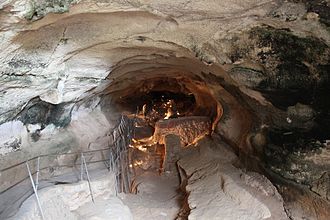
Għar Dalam
Għar Dalam [A] is a 144-metre long phreatic tube and cave, located in the outskirts of Birżebbuġa, Malta. The cave contains the bones of animals that lived on Malta during the Pleistocene and Holocene epochs. It has lent its name to the early Neolithic-aged Għar Dalam phase in Maltese prehistory, and is viewed as one of Malta's most important national monuments. Pottery similar to that found in Stentinello was found at Għar Dalam, but lacking details such as stamp decorations.

Our Lady of Victory Church
The Our Lady of Victory Church, formerly known as the Saint Anthony the Abbot Church, was the first church and building completed in Valletta, Malta. In 1566, following the Great Siege of Malta, Grand Master Jean Parisot de Valette and his Order showed interest to build a church in the name of the Nativity of the Virgin as a form of thanksgiving; the construction was funded by de Valette.

Ta' Ħaġrat
The Ta' Ħaġrat temples in Mġarr, Malta are recognized as a UNESCO World Heritage Site, along with several other Megalithic temples. They are amongst the world's oldest religious sites. The larger Ta' Ħaġrat temple dates from the Ġgantija phase ; the smaller temple is dated to the Saflieni phase.
Places from Wikidata and Wikipedia.
Contains affiliate links.