Things to do in Kuwait City
Top sights and attractions to build your days around once you know when to go.

Kuwait Towers
The Kuwait Towers are a group of three thin towers in Kuwait City, standing on a promontory into the Persian Gulf. They were the sixth, and last, group in the larger Kuwait Water Towers system of 34 towers, and were built in a style considerably different from the other five groups. The Kuwait Towers were officially inaugurated in March 1979 and are regarded as a landmark and symbol of modern Kuwait. The towers were closed for maintenance from March 2012 to 8 March 2016, with a massive fireworks festival commemorating the re-opening. Kuwait Towers facility is operated and managed by the state-owned Touristic Enterprises Company. The Main Tower served as the venue for TEDxKuwaitCity event in 2018 and 2019.

Jaber Al-Ahmad International Stadium
Jaber Al-Ahmad International Stadium is a multi-purpose stadium in the Ardiya area of Kuwait City, Kuwait. Completed in 2009, it is used mostly for football matches and athletics. The stadium has a capacity of 60,000 spectators. It was expected to open in the second quarter of 2010, but the building failed structural-integrity testing. It was finally opened on 18 December 2015. Jaber Al-Ahmad stadium is the main home of the Kuwait national football team. The stadium was named after late Amir of Kuwait, Shaikh Jaber Al-Ahmad Al-Sabah. Kuwait celebrated their winning of the 20th Arabian Gulf Cup at the stadium.

Grand Mosque
The Grand Mosque, located in Kuwait City, is the largest mosque in Kuwait. Its area spans 45,000 square metres (480,000 sq ft), out of which the building itself covers 20,000 square metres (220,000 sq ft). The main prayer hall is 72 metres (236 ft) wide on all sides, and has teakwood doors. Natural lighting is provided by 144 windows.

Al-Sadaqua Walsalam Stadium
The Al-Sadaqua Walsalam Stadium is a multi-purpose stadium in Adiliya Kuwait City, Kuwait. It is currently used mostly for football matches. The second largest stadium in Kuwait, it can accommodate 21,500 spectators. The stadium has hosted many finals for the Kuwait Emir Cup and Kuwait Crown Cup. In addition, 2 Gulf Cup Tournaments were held in this Stadium, the first taking place in 1990 where Kuwait won the 10th Gulf Cup trophy, and the second in 2003, where they finished 6th. WWE also hosted its Kuwait International Tournament at the stadium in 1997.
Sabah Al Salem Stadium
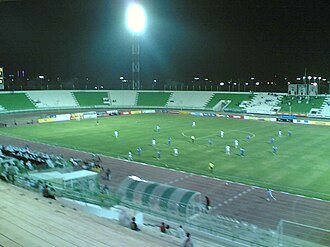
Sabah al-Salem Stadium is a multi-purpose stadium in Kuwait City, Kuwait. It is currently used mostly for football matches. The stadium holds 26,000 people and had hosted many matches of the 1980 AFC Asian Cup, including the final. It is the home stadium of Al-Arabi.

Kuwait National Museum
The Kuwait National Museum is the national museum of Kuwait, located in Kuwait City. It was established in 1983 and designed by architect Michel Ecochard.

Ali Al-Salem Al-Sabah Stadium
Ali Al-Salem Al-Sabah Stadium is a multi-use stadium in Ardiya, Kuwait. It is currently used mostly for football matches, on club level by Al-Nasr SC of the Kuwaiti Premier League. The stadium has a capacity of 11,000 spectators.

Imam Hussein Mosque
Imam Hussein Mosque, in Midan Hawalli District, Kuwait City, is the largest Shi'a mosque in Kuwait. Its prayer hall accommodates about 4,000 to 5,000 men and 500 to 1,000 women. The mosque was built in 1986. It was unharmed in the 1990 invasion of Kuwait.
Mohammed Al-Hamad Stadium
Mohammed al-Hamad Stadium is a multi-purpose stadium designed and certified meeting FIFA international standards in Hawally, Kuwait. It is currently used mostly for football matches. The stadium holds 22,000.

Thamir Stadium
Thamir Stadium is a multi-purpose stadium in Al Salmiya, Kuwait. It is currently used mostly for football matches and is the home stadium of Al Salmiya Club. The stadium holds 16,105 people.

Tareq Rajab Museum
The Tareq Rajab Museum is located in Kuwait and houses an extensive collection of artefacts accumulated over a fifty-year period commencing in the 1950s. The Museum is housed at two separate locations in Jabriya, Kuwait: the Tareq Rajab Museum, which was founded in 1980, and the Tareq Rajab Museum of Islamic Calligraphy in 2007. The Tareq Rajab Museum includes collections of manuscripts and miniatures, ceramics, metalwork, glass, arms and armour as well as textiles, costumes and jewellery. The museum's ceramics collection is very large and comprehensive, and includes objects from pre-Islamic times up to the early 20th century and from across the breadth of the Islamic world. The museum houses one of the foremost collections of silver jewellery as well as a fine collection of gold jewellery much of which dates from pre-Islamic times. There is a large collection of Qurans and manuscripts from all periods, with the earliest dating to the 7th century AD and from across the whole Islamic world. From important Qurans, to rare manuscripts such as the Al-Kindi book on optics and a folio from the Shahnameh of Shah Tahmasp, the range of works is comprehensive and representative of many styles and regions.
Places from Wikidata and Wikipedia.
Contains affiliate links.