Things to do in Dublin
Top sights and attractions to build your days around once you know when to go.

Aviva Stadium
Aviva Stadium, also known as the Dublin Arena, is a sports stadium located in Dublin, Ireland. It has a capacity of 51,711. It is built on the site of the former Lansdowne Road Stadium, which was demolished in 2007, and replaced it as home to its chief tenants: the Ireland national rugby union team and the Republic of Ireland football team. The decision to redevelop the stadium came after plans for both Stadium Ireland and Eircom Park fell through. Aviva Group Ireland signed a 10-year deal for the naming rights in 2009, and subsequently extended the arrangement in 2018 and 2025. The deal signed in 2025 runs until 2030.
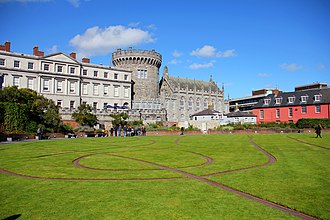
Dublin Castle
Dublin Castle is a major Irish government complex, conference centre, and tourist attraction. It is located off Dame Street in central Dublin.

Croke Park
Croke Park is a Gaelic games stadium in Dublin, Ireland. Named after Archbishop Thomas Croke, it is referred to as Croker by GAA fans and locals. It is the headquarters of the Gaelic Athletic Association (GAA). Since 1891 the site has been used by the GAA to host Gaelic sports, including the annual All-Ireland finals in Gaelic football and hurling.

St Patrick's Cathedral
Saint Patrick's Cathedral in Dublin, Ireland is the national cathedral of the Church of Ireland. Christ Church Cathedral, also a Church of Ireland cathedral in Dublin, is designated as the local cathedral of the Diocese of Dublin and Glendalough.

National Library of Ireland
The National Library of Ireland is Ireland's national library located in Dublin, in a building designed by Thomas Newenham Deane. The mission of the National Library of Ireland is "To collect, preserve, promote and make accessible the documentary and intellectual record of the life of Ireland and to contribute to the provision of access to the larger universe of recorded knowledge."

Spire of Dublin
The Spire of Dublin, alternatively titled the Millennium Spire or the Monument of Light, is a large, stainless steel, pin-like monument 120 metres (390 ft) in height, located on the site of the former Nelson's Pillar on O'Connell Street, the main thoroughfare of Dublin, Ireland.

Leinster House
Leinster House is the seat of the Oireachtas, the parliament of Ireland. Originally, it was the ducal palace of the Dukes of Leinster.

National Gallery of Ireland
The National Gallery of Ireland houses the national collection of Irish and European art. It is located in the centre of Dublin with one entrance on Merrion Square, beside Leinster House, and another on Clare Street. It was founded in 1854 and opened its doors ten years later. The gallery has an extensive, representative collection of Irish paintings and is also notable for its Italian Baroque and Dutch masters painting. The current director is Caroline Campbell.

Christ Church Cathedral, Dublin
Christ Church Cathedral, more formally The Cathedral of the Holy Trinity, is the cathedral of the United Dioceses of Dublin and Glendalough and the cathedral of the ecclesiastical province of the United Provinces of Dublin and Cashel in the (Anglican) Church of Ireland. It is situated in Dublin, Ireland, and is the elder of the capital city's two medieval cathedrals, the other being St Patrick's Cathedral.

Phoenix Park
The Phoenix Park is a large public urban park in Dublin, Ireland, lying 2–4 kilometres (1.2–2.5 mi) west of the city centre, north of the River Liffey. Its 11 kilometres (6.8 mi) perimeter wall encloses 707 hectares of recreational space. It includes large areas of grassland and tree-lined avenues, and since the 17th century has been home to a herd of wild fallow deer. The Irish Government has lobbied UNESCO to have the park designated as a World Heritage Site.

Saint Stephen's Green
St Stephen's Green is a garden square and public park located in the city centre of Dublin, Ireland. The current landscape of the park was designed by William Sheppard. It was officially re-opened to the public on Tuesday, 27 July 1880 by Lord Ardilaun. The square is adjacent to one of Dublin's main shopping streets, Grafton Street, and to a shopping centre named after it, while on its surrounding streets are the offices of a number of public bodies as well as a stop on one of Dublin's Luas tram lines. It is often informally called Stephen's Green. At 22 acres (8.9 ha), it is the largest of the parks in Dublin's main Georgian garden squares. Others include nearby Merrion Square and Fitzwilliam Square.

National Museum of Ireland
The National Museum of Ireland is Ireland's leading museum institution, with a strong emphasis on national and some international archaeology, Irish history, Irish art, culture, and natural history. It has three branches in Dublin, the archaeology and natural history museums adjacent on Kildare Street and Merrion Square, and a newer Decorative Arts and History branch at the former Collins Barracks, and the Country Life museum in County Mayo.
Places from Wikidata and Wikipedia.
Contains affiliate links.