Things to do in Dresden
Top sights and attractions to build your days around once you know when to go.

Church of Our Lady
The Frauenkirche is a Lutheran church in Dresden, the capital of the German state of Saxony. Destroyed during the Allied firebombing of Dresden towards the end of World War II, the church was reconstructed between 1994 and 2005.

Zwinger
The Zwinger is a palatial complex with gardens in Dresden, Germany. Designed by architect Matthäus Daniel Pöppelmann, it is one of the most important buildings of the Baroque period in Germany. Along with the Frauenkirche, the Zwinger is the most famous architectural monument of Dresden.

Gemäldegalerie Alte Meister
The Gemäldegalerie Alte Meister in Dresden, Germany, displays around 750 paintings from the 15th to the 18th centuries. It includes major Italian Renaissance works as well as Dutch and Flemish paintings. Outstanding works by German, French, and Spanish painters of the period are also among the gallery's attractions.

Dresden Cathedral
Dresden Cathedral, or the Cathedral of the Holy Trinity, Dresden, previously the Catholic Church of the Royal Court of Saxony, called in German Katholische Hofkirche and since 1980 also known as Kathedrale Sanctissimae Trinitatis, is the Catholic Cathedral of Dresden.

Dresden Castle
Dresden Castle or Royal Palace is one of the oldest buildings in Dresden, Germany. For almost 400 years, it was the residence of the electors (1547–1806) and kings (1806–1918) of Saxony from the Albertine House of Wettin as well as Kings of Poland (1697–1763). It is known for the different architectural styles employed, from Baroque to Neo-Renaissance.

Rudolf-Harbig-Stadion
Rudolf-Harbig-Stadion is a stadium in Dresden, Saxony, Germany. It is named after athlete Rudolf Harbig and is the current home of Dynamo Dresden. It also hosts fixtures of the German national team on an irregular basis since 1911. Sports facilities have existed on the site of the stadium, the Güntzwiesen, since 1874.

Green Vault
The Green Vault is a museum located in Dresden, Germany, which contains the largest treasure collection in Europe. The museum was founded in 1723 by Augustus the Strong of Poland and Saxony, and features a variety of exhibits in styles from Baroque to Classicism. The Green Vault is named after the formerly malachite green-painted column bases and capitals of the initial rooms. It is one of the oldest museums in the world; it is older than the British Museum, opened in 1759, but the Kunstkamera in St. Petersburg, Russia was opened in 1714 and the Vatican Museums date their foundation to the public display of the newly excavated Laocoön group in 1506.
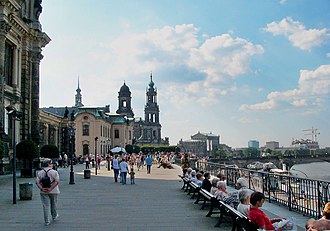
Brühl's Terrace
Brühl's Terrace is a historic architectural ensemble in Dresden, Germany. Nicknamed "The Balcony of Europe", the terrace stretches high above the bank of the river Elbe, and is located north of the recently rebuilt Neumarkt Square and the Frauenkirche.

Kreuzkirche
The Dresden Kreuzkirche is a Lutheran church in Dresden, Germany. It is the main church and seat of the Landesbischof of the Evangelical-Lutheran Church of Saxony, and the largest church building in the Free State of Saxony. It also is home of the Dresdner Kreuzchor boys' choir.

Albertinum
The Albertinum is a modern art museum. The sandstone-clad Renaissance Revival building is located on Brühl's Terrace in the historic center of Dresden, Germany. It is named after King Albert of Saxony.

Staatliche Kunstsammlungen Dresden
Staatliche Kunstsammlungen Dresden is a cultural institution in Dresden, Germany, owned by the State of Saxony. It is one of the most renowned and oldest museum institutions in the world, originating from the collections of the Saxon electors in the 16th century.

Galerie Neue Meister
The Galerie Neue Meister in Dresden, Germany, displays around 300 paintings from the 19th century until today, including works from Otto Dix, Edgar Degas, Vincent van Gogh and Claude Monet. The gallery also exhibits a number of sculptures from the Dresden Sculpture Collection from the same period. The museum's collection grew out of the Old Masters Gallery, for which contemporary works were increasingly purchased after 1843.
Places from Wikidata and Wikipedia.
Contains affiliate links.