Discover the best time of year, based on historical climate, temperature, and precipitation.
The best weather in Bologna is from June, September, October, but considering flight prices and crowds, the best months to visit are April, June, October. — variable climate
🌥Mild
Contains affiliate links.
| Score | 29 | 34 | 55 | 80 | 74 | 87 | 67 | 76 | 84 | 81 | 45 | 26 |
|---|---|---|---|---|---|---|---|---|---|---|---|---|
| Climate | Cold | Cold | Cold | Mild | Cool & rainy | Pleasant | Hot & dry | Pleasant | Pleasant | Mild | Cold | Cold |
| Temperature | 1–8°C | 3–11°C | 5–15°C | 8–18°C | 13–22°C | 18–28°C | 21–32°C | 20–31°C | 16–25°C | 12–20°C | 6–13°C | 2–9°C |
| Feels like | -3–6°C | 0–9°C | 2–12°C | 6–17°C | 12–22°C | 18–30°C | 22–34°C | 21–33°C | 16–26°C | 11–20°C | 4–12°C | -1–7°C |
| Precipitation | 43mm 8 days | 88mm 9 days | 58mm 9 days | 59mm 10 days | 132mm 11 days | 63mm 8 days | 39mm 7 days | 49mm 8 days | 78mm 8 days | 77mm 8 days | 92mm 10 days | 63mm 9 days |
| Sunshine | 6.2h ☀︎ 67% | 7.0h ☀︎ 67% | 8.9h ☀︎ 75% | 10.5h ☀︎ 78% | 10.8h ☀︎ 73% | 13.1h ☀︎ 85% | 13.5h ☀︎ 89% | 12.1h ☀︎ 87% | 10.3h ☀︎ 82% | 7.7h ☀︎ 70% | 5.9h ☀︎ 62% | 5.4h ☀︎ 60% |
| Wind | W · 12 km/h | SW · 14 km/h | SW · 16 km/h | S · 16 km/h | S · 15 km/h | SW · 15 km/h | S · 14 km/h | S · 14 km/h | SW · 14 km/h | SW · 13 km/h | W · 12 km/h | W · 11 km/h |
| Humidity (%) | 81% | 78% | 70% | 67% | 71% | 62% | 56% | 58% | 67% | 78% | 83% | 85% |
| Perfect days | 0% | 0% | 8% | 32% | 51% | 27% | 9% | 11% | 50% | 39% | 2% | 0% |
| Dry streak | 14d | 11d | 12d | 9d | 9d | 12d | 11d | 10d | 9d | 11d | 10d | 12d |
| Sunny streak | 9d | 12d | 14d | 15d | 18d | 24d | 27d | 26d | 15d | 12d | 7d | 8d |
| Extreme heat | — | — | — | — | — | 3% | 14% | 11% | 0% | — | — | — |
| Extreme cold | 45% | 33% | 11% | 1% | — | — | — | — | — | — | 5% | 36% |
| Temperature | -0.2° | +2.2° | +0.6° | -0.9° | -2.0° | +0.5° | +0.3° | +1.8° | +0.8° | +1.2° | -0.3° | +0.5° |
| Rainfall | Stable | Stable | Getting drier | Stable | Getting wetter | Stable | Stable | Stable | Stable | Stable | Stable | Stable |
| Ideal warm days | 0% | 0% | 0% | 1% | 16% | 42% | 33% | 38% | 32% | 4% | 0% | 0% |
| Outdoor comfort | 0% | 0% | 12% | 37% | 49% | 19% | 6% | 9% | 45% | 46% | 5% | 0% |
| Dry week odds | 36% | 28% | 25% | 14% | 17% | 28% | 25% | 19% | 16% | 24% | 19% | 25% |
| Heavy rain | 1% | 4% | 2% | 2% | 4% | 2% | 1% | 1% | 2% | 2% | 3% | 2% |
| Snow days | 13% | 13% | 7% | — | — | — | — | — | — | — | 3% | 11% |
| Muggy days | — | — | — | — | — | 1% | 2% | 2% | — | — | — | — |
| Day length | 9.3h | 10.5h | 11.9h | 13.5h | 14.8h | 15.5h | 15.1h | 14.0h | 12.5h | 11.0h | 9.6h | 8.9h |
| Tourist Crowds | Low season | Low season | Low season | Shoulder season | High season | High season | High season | High season | High season | Shoulder season | Low season | Low season |
Arte Fiera is one of Italy's most important contemporary art fairs, attracting collectors and enthusiasts from around th…
The Bologna Children's Book Fair is the world's leading professional event for children's publishing, attracting illustr…
Il Cinema Ritrovato is an internationally acclaimed film festival dedicated to the restoration and rediscovery of classi…
Bologna Estate is a comprehensive summer program featuring open-air concerts, film screenings, theater performances, and…
The Bologna Jazz Festival brings renowned international and Italian jazz artists to various venues across the city. Taki…
The Festa di San Petronio celebrates Bologna's patron saint with religious ceremonies, cultural events, and fireworks. H…
The Fiera di Santa Lucia is Bologna's traditional Christmas market, dating back centuries, offering festive decorations,…
While standard travel wisdom points to June for sun-drenched squares, October is Bologna's true zenith—offering the year's thinnest crowds, gentle autumn air, and a city returned to its residents.
Bologna does not exist to serve tourists; it exists to educate scholars, feed northern Italy, and nurture intellectual dissent. Sheltered by nearly forty kilometres of medieval and Renaissance porticoes—now protected as UNESCO World Heritage—the city functions almost entirely at pavement level. Because of its massive university and relentless trade calendar, conventional tourist seasons flip upside down here. If you visit when the guidebooks tell you to go, you will shoulder your way through trade delegates and sweat under stagnant Po Valley heat. Wait until the calendar turns, however, and the city reveals why it is Italy's most effortlessly livable metropolis.
A weather-only algorithm will urge you toward early summer, but October is where Bologna actually delivers perfection. By the time autumn settles in, the suffocating summer haze has drained away, leaving crisp afternoons hovering near twenty degrees and evenings that carry the scent of roasted chestnuts. More importantly, the human density drops to its annual low.
This is when the city belongs to Bolognesi again. On October 4th, the Festa di San Petronio brings community gatherings and fireworks around Piazza Maggiore, celebrating the city's patron saint without tourist theatricality. Soon after, the Bologna Jazz Festival spills music across theaters and clubs. Walking from the porticoed arcades of the Quadrilatero up through the long vaulted climb toward the Santuario della Madonna di San Luca feels serene rather than frantic. You get the full richness of Emilia-Romagna's culinary and architectural heart without competing for space under the arches.
June produces the year's highest weather scores on paper, but the Po Valley acts as a thermal trap. By late June and into July, apparent temperatures frequently climb into the mid-thirties. The heavy, still air can make the cobblestones between the Due Torri and the university district along Via Zamboni feel like an oven before twilight.
Yet summer has a saving grace that makes the swelter tolerable: Bologna lives outdoors after dark. The sprawling Bologna Estate program fills parks and piazzas with live performances, while Il Cinema Ritrovato turns Piazza Maggiore into the continent's most majestic open-air screening room. Thousands of film lovers sit silently under starry skies as restored masterpieces flicker against the ancient façade of the Basilica di San Petronio. If you visit in summer, copy the locals: retreat inside during the baking afternoon, and claim the night.
September provides a glorious bridge between the dog days and deep autumn. Temperatures settle into an easy, warm rhythm that invites all-day wandering through the green lawns of Giardini Margherita. The Bologna Estate festivities linger into the first half of the month, making evening strolls lively and unhurried.
Toward the end of September, the oldest continuously operating university in the Western world shakes off its summer slumber. Thousands of international and Italian students pour back into the student quarter around Via Zamboni, filling courtyards with animated debates and spontaneous bicycle traffic. There is a palpable surge of youthful intellectual energy that defines the city's modern soul.
Spring sounds tempting on paper, with wildflowers blooming in the foothills and pleasant daylight hours. In reality, May is Bologna's most overwhelmed month of the year, driven by colossal industry trade shows and school trips that saturate every corner of the historic center. May also brings the year's most torrential rain, soaking the streets in sudden, heavy deluges.
April offers slightly better breathing room, but late March and early April are regularly disrupted by massive corporate crowds for events like the Bologna Children's Book Fair. During these weeks, finding a quiet corner in the medieval heart is nearly impossible. If you must visit in spring, rely on the porticoes to keep you dry, but prepare for bustling pavements and a city running at full commercial throttle.
Winter in Bologna brings a distinct northern chill. Wet fog regularly blankets the terracotta rooftops, and raw, damp cold seeps off the stones. Yet this is an undeniably atmospheric season. By late November, the centuries-old Fiera di Santa Lucia opens its stalls beneath the sweeping porticoes, perfuming the winter air with torrone and roasted nuts as holiday lights illuminate the colonnades.
January and February bring the coldest drafts, but culture steps in to take up the slack. Arte Fiera lands in late January, filling the city with collectors, gallery openings, and avant-garde exhibits that make indoor afternoons exceptionally rewarding. Bologna's winter calls for woolen coats, museum days, and slow, hearty meals sheltered from the damp Po Valley winds.
Top sights and attractions to build your days around once you know when to go.
Stadio Renato Dall'Ara is a multi-purpose stadium in Bologna, Italy. It is currently used mostly for football matches and the home of Bologna FC. The stadium was designed by Giulio Ulisse Arata and inaugurated in 1927 as Stadio Littoriale. It was one of the first stadiums to incorporate the stands into the architecture, an innovation which later became the model for stadiums around the world. The large arch contained an equestrian statue of the dictator Benito Mussolini, which was destroyed during the city's liberation in 1943. The stadium replaced the Stadio Sterlino and is named after Renato Dall'Ara (1892–1964), a former president of Bologna for thirty years.
The Basilica of San Petronio is a minor basilica and church of the Archdiocese of Bologna located in Bologna, Emilia-Romagna, northern Italy. It dominates Piazza Maggiore. The basilica is dedicated to the patron saint of the city, Saint Petronius, who was the Bishop of Bologna in the fifth century. Construction began in 1390 and its main façade has remained unfinished since. The building was transferred from the city to the diocese in 1929; the basilica was finally consecrated in 1954. It has been the seat of the relics of Bologna's patron saint only since 2000; until then, they were preserved in the Santo Stefano church.
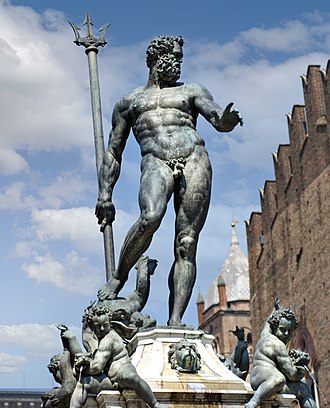
The Fountain of Neptune is a monumental civic fountain located in the eponymous square, Piazza del Nettuno, next to Piazza Maggiore, in Bologna, Italy. The fountain is a model example of Mannerist taste of the Italian courtly elite in the mid-sixteenth century.
The Sanctuary of the Madonna of San Luca is a basilica church located in Bologna, northern Italy, situated atop the forested hill of Colle della Guardia, approximately 300 metres above the city plain, just southwest of the historical centre.
Palazzo Re Enzo is a palace located on Piazza del Nettuno, 1 in the historic center of Bologna, northern Italy. The palace takes its name from Enzio of Sardinia, Frederick II's son, who was prisoner here from 1249 until his death in 1272. The palace is presently used to sponsor cultural events and exhibitions.
The Basilica of San Domenico is one of the major churches in Bologna, Italy. The remains of Saint Dominic, founder of the Order of Preachers (Dominicans), are buried inside the exquisite shrine Arca di San Domenico, made by Nicola Pisano and his workshop, Arnolfo di Cambio and with later additions by Niccolò dell'Arca and the young Michelangelo.
Bologna Cathedral, formally known as the Metropolitan Cathedral of Saint Peter, is the cathedral of Bologna, Italy, and the seat of the Archbishop of Bologna. Dedicated to Saint Peter, most of the present structure dates to the 17th century, with some parts dating back to the late 16th century.
The National Art Gallery of Bologna is a museum in Bologna, Italy. It is located in the former Saint Ignatius Jesuit novitiate of the city's University district, and inside the same building that houses the Academy of Fine Arts. The museum offers a wide collection of Emilian paintings from the 13th to the 18th century and other fundamental works by artists who were in some way related to the city.
The Palazzo del Podestà is a civic building in Bologna, northern Italy.
Palazzo d'Accursio is a palace once formulated to house major administrative offices of the city of Bologna, region of Emilia-Romagna, Italy. It is located on the Piazza Maggiore, and is the city's Town Hall. The palace is also home to the Civic Art Collection, with paintings from the Middle Ages to the 19th century; the Museo Morandi, with the works by Giorgio Morandi; and the Biblioteca Salaborsa, the town libraries.
The Basilica of Santo Stefano encompasses a complex of religious edifices in the city of Bologna, Italy. Located on Piazza Santo Stefano, it is locally known as Sette Chiese and Santa Gerusalemme. It has the dignity of minor basilica.
The Archaeological Civic Museum of Bologna is located in the fifteenth-century Palazzo Galvani building at Via dell'Archiginnasio 2 postal code 40124 Bologna, once known as the Hospital of Death. Founded in September 1881 by the merging of two separate museums: the one belonging to the University of Bologna – heir of the Room of Antiquity belonging to the Academy of Sciences founded by Luigi Ferdinando Marsili in (1714) – and that belonging to the City of Bologna (enriched by the antique collection of Artist Pelagio Palagi and the large amount of finds from excavations conducted in and around Bologna during these times.
Places from Wikidata and Wikipedia.
Contains affiliate links.