Things to do in Belfast
Top sights and attractions to build your days around once you know when to go.

Windsor Park
The National Football Stadium at Windsor Park, or the National Football Stadium, also known as Windsor Park is a football stadium in Belfast, Northern Ireland. It is the home ground of Linfield who own the land the stadium is built on, while the Irish Football Association own and operate the stadium and pay Linfield an annual rental fee for the use of the land on behalf of the Northern Ireland national football team. The stadium is usually where the Irish Cup final is played.

The Oval
The Oval is a football stadium in Belfast, Northern Ireland, which has been home to Glentoran F.C. since 1892.

Belfast Castle
Belfast Castle is a mansion located in Cave Hill Country Park in Belfast, Northern Ireland, in a prominent position 400 feet (120 m) above sea level. Its location provides unobstructed views over the City of Belfast and Belfast Lough. There have been several structures called "Belfast Castle" over the centuries, located on different sites. The current "castle" is a Victorian structure that was built between 1867 and 1870 on the slopes of Cave Hill, and it is Grade A listed. The main entrance into the Belfast Castle Demesne is now where Innisfayle Park meets Downview Park West, just off the Antrim Road. The original main entrance into the current demesne was formerly on the Antrim Road itself, where Strathmore Park now meets the Antrim Road.

SS Nomadic
SS Nomadic is a former tender of the White Star Line, launched on 25 April 1911 at Belfast, that is now on display in Belfast's Titanic Quarter. She was built to transfer passengers and mail to and from the ocean liners RMS Olympic and RMS Titanic. She is the only surviving vessel designed by Thomas Andrews, who also helped design those two ocean liners, and the last White Star Line vessel in existence today.

Botanic Gardens
Botanic Gardens is a public garden in Belfast, Northern Ireland.

Ravenhill Stadium
Ravenhill Stadium is a rugby stadium located in Belfast, Northern Ireland. It is the home of Ulster Rugby. With the opening of a new stand for the 2014 Heineken Cup quarter-final against Saracens on 5 April 2014, the capacity of the stadium is now 18,196. The stadium is owned by the Irish Rugby Football Union.

St Anne's Cathedral, Belfast
St Anne's Cathedral is a Romanesque-style Anglican cathedral in Donegall Street, Belfast, Northern Ireland. It is unusual in serving two separate dioceses. It is the focal point of Belfast's Cathedral Quarter.

Solitude
Solitude is a football stadium in north Belfast, Northern Ireland. Home ground of Ireland's oldest football club, Cliftonville, it is the oldest football stadium in Ireland. The stadium holds 6,224, but is currently restricted to 2,530 under safety legislation with the old main stand now closed.
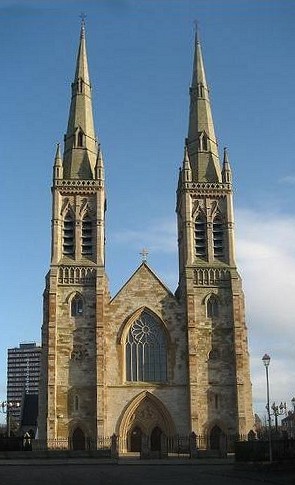
St Peter's Cathedral
Saint Peter's Cathedral, Belfast, is the Catholic cathedral church for the Diocese of Down and Connor, and is therefore the episcopal seat of the Catholic Bishop of Down and Connor. It is located in the Divis Street area of the Falls Road in Belfast, Northern Ireland, and construction began in the 1860s. There are three choirs: the Cathedral Choir, the Down & Connor Schola Cantorum and the Cathedral Girls’ Choir.

HMS Caroline
HMS Caroline is a decommissioned C-class light cruiser of the Royal Navy that was the lead ship of her sub-class. Completed in 1914, she saw combat service during the First World War and served as an administrative centre in the Second World War. The ship served as a static headquarters and training ship for the Royal Naval Reserve, based in Alexandra Dock, Belfast, Northern Ireland, for the later stages of her career. At the time of her decommissioning in 2011, she was the second-oldest ship in Royal Navy service, after the ship-of-the-line HMS Victory. Caroline was converted into a museum ship after she was decommissioned. From October 2016, she underwent inspection and repairs to her hull at Harland and Wolff and opened to the public on 1 July 2017 at Alexandra Dock in the Titanic Quarter in Belfast.

Ulster Museum
The Ulster Museum, located in the Botanic Gardens in Belfast, has around 8,000 square metres of public display space, featuring material from the collections of fine art and applied art, archaeology, ethnography, treasures from the Spanish Armada, local history, numismatics, industrial archaeology, botany, zoology and geology. It is the largest museum in Northern Ireland, and one of the components of National Museums Northern Ireland.

Seaview
Seaview is a football stadium in Belfast, Northern Ireland. It is the home ground of Crusaders, and traditionally hosts the final of the Steel & Sons Cup on Christmas Day. The stadium holds 3,383, and has a 4G playing surface.
Places from Wikidata and Wikipedia.
Contains affiliate links.